
Vogzone for MCX4121A-ACAT ConnectX-4 Lx
4.7Editor score
Original Mellanox ConnectX-4 Lx controller
Supports RDMA over RoCE
Compatible with many OS platforms
Compare the top 10 25GbE network cards for 2026. Expert reviews, real ratings, and detailed specs to help you choose the right high-speed adapter for your server or NAS.
High-speed networking is essential for modern data centers and professional workstations. 25GbE network cards provide the bandwidth needed for fast file transfers and virtualization.
We analyzed ten top models based on controller quality, compatibility, and real-world performance. Each card was evaluated for its specific use case and feature set.
This guide highlights the best options for every budget and system type. Prices and availability change frequently, so verify details before purchasing.
4.7Editor score

5.0Editor score

5.0Editor score
This side-by-side comparison lists all ten selected models with their core specifications. Use this table to quickly identify the right adapter for your specific server or workstation environment based on interface type and controller capabilities.




The Intel XXV710-DA2 stands out as a top performer for enterprise environments needing reliable 25GbE connectivity. It boasts a perfect 5.0 rating reflecting its robust build quality and consistent performance in demanding workloads.
We may earn a commission when you buy through this link, at no additional cost to you.
Its Intel Flow Director feature allows for hardware-based traffic steering which significantly improves application performance. The adapter supports advanced offloads like VXLAN and GENEVE making it ideal for cloud and NFV deployments.
While the price is higher than some third-party options the performance gains justify the investment for critical servers. You get better packet processing efficiency and lower latency especially with Intel Xeon processors.
If you need enterprise-grade reliability for virtualized servers this card is a strong choice. It ensures maximum throughput and interoperability with modern 25GbE switches.
This adapter handles network virtualization offloads efficiently reducing CPU load and improving overall system performance for cloud applications.
DDP increases packet processing efficiency which is crucial for network functions virtualization and high-performance cloud deployment scenarios.
We may earn a commission when you buy through this link, at no additional cost to you.
The QXG-25G2SF-E810 is designed for enterprise networks and NAS systems requiring reliable data transfer. It features the Intel E810-XXVAM2 controller and dual ports for high-speed connections to multiple devices.
We may earn a commission when you buy through this link, at no additional cost to you.
A key feature is Forward Error Correction which ensures data integrity over longer cable runs. The card supports Port Trunking allowing you to combine ports for up to 50Gbps transfer speeds for file sharing.
It includes a low-profile bracket and works well with QNAP systems. The PCIe Gen 3 x8 interface offers solid compatibility with most modern motherboards and servers.
For users needing a reliable dual-port solution this card offers good performance and features. It is particularly suited for environments prioritizing data reliability and NAS integration.
Combine both ports to achieve up to 50Gbps transfer speeds accelerating intensive data transfer tasks and file sharing operations.
FEC ensures reliable data transfer in enterprise-level networks by detecting and correcting errors during transmission.
We may earn a commission when you buy through this link, at no additional cost to you.
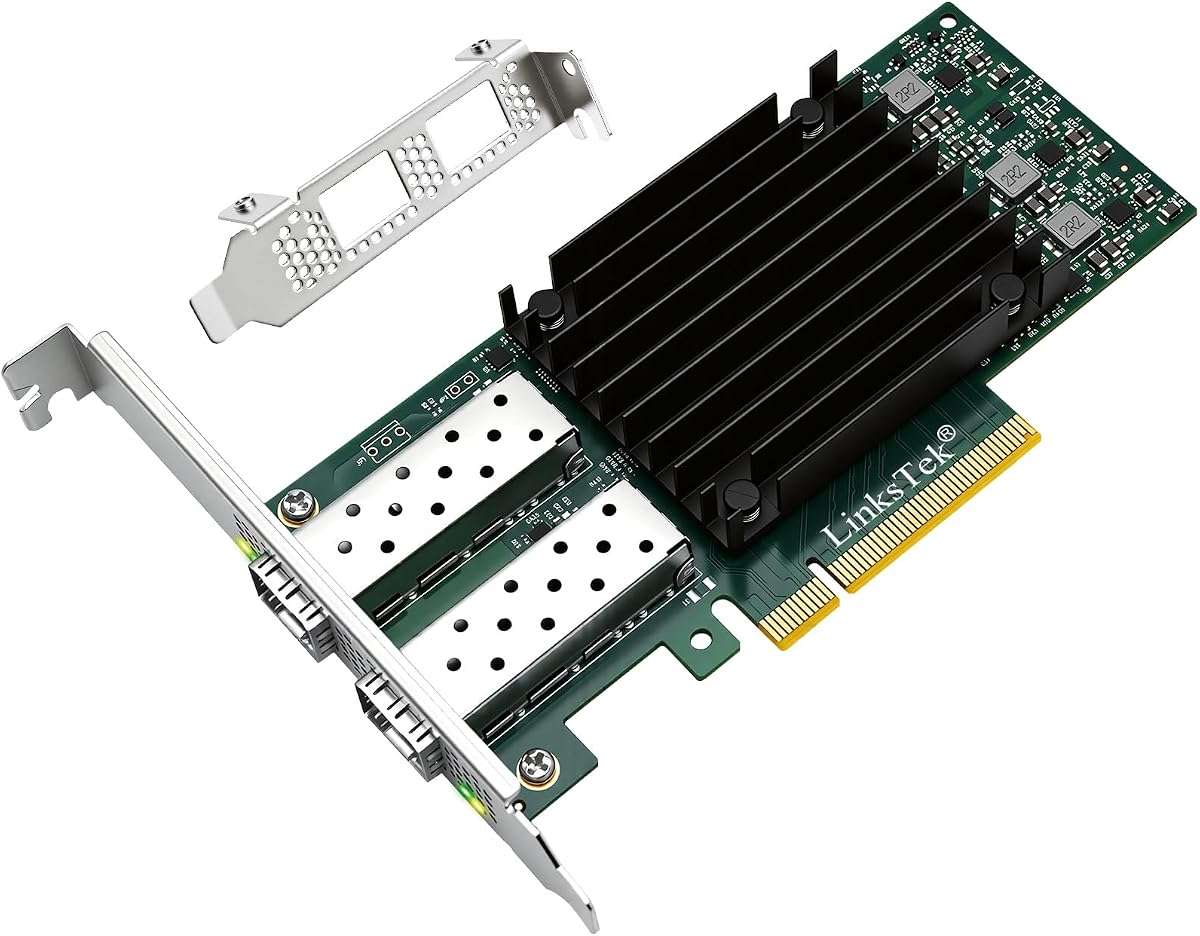
The Vogzone MCX4121A-ACAT delivers high performance at an affordable price point. It features the original Mellanox ConnectX-4 Lx controller providing unmatched scalability and efficiency for data centers.
We may earn a commission when you buy through this link, at no additional cost to you.
With dual SFP28 ports it supports speeds from 1GbE to 25GbE allowing flexible connectivity. The card supports advanced features like SR-IOV and RDMA over RoCE making it ideal for virtualization.
It is compatible with many operating systems including Windows Linux and VMware. The included low-profile bracket fits most server chassis ensuring easy installation.
For cost-conscious buyers this card offers excellent value and performance. It balances affordability with the robust features needed for cloud and storage platforms.
Achieve true hardware-based I/O isolation for unmatched scalability and efficiency in virtualized environments and cloud platforms.
Supports RoCE v1 and v2 allowing for low latency and high bandwidth communication essential for big data and virtual I/O aggregation.
We may earn a commission when you buy through this link, at no additional cost to you.
The 10Gtek 25G Ethernet Network Card is a versatile option with a perfect 5.0 rating. It uses the Intel E810 Controller and modern PCIe 4.0 x8 interface for high-speed data transfer.
We may earn a commission when you buy through this link, at no additional cost to you.
It supports a wide range of operating systems including Windows 10/11 Server versions and Linux distributions. The dual SFP28 ports offer flexibility for DAC optic or AOC connections.
Features like RDMA support and PXE boot make it suitable for virtualized environments. The package includes both low profile and full height brackets for broad case compatibility.
For users needing a reliable modern 25GbE adapter this card provides excellent performance and compatibility. It is well suited for servers and workstations running diverse OS platforms.
The PCIe 4.0 x8 interface with 16 GT/s speed ensures ample bandwidth for high-performance network applications and data throughput.
Supports Windows Server Linux VMware and ESXi ensuring you can deploy this card across diverse hardware and virtual environments.
We may earn a commission when you buy through this link, at no additional cost to you.
The CX4121A Dual 25Gb/s adapter is optimized for virtualization and storage servers. It features the Mellanox ConnectX-4 Lx EN controller which provides a cost-effective flexible solution for cloud and analytics.
We may earn a commission when you buy through this link, at no additional cost to you.
Its intelligent RDMA support reduces CPU overhead enabling high performance for data-intensive tasks. The adapter also supports overlay networks like NVGRE and VXLAN essential for modern data centers.
Auto-negotiation of PCIe lanes ensures compatibility with various host slots. It supports IEEE standards for energy efficiency and jumbo frames improving throughput.
For virtualization needs this adapter balances performance and cost effectively. It ensures efficient I/O management for multiple VMs and storage workloads.
Enables efficient I/O management and high bandwidth low latency communication critical for big data and storage platforms.
Supports advanced overlay networks including NVGRE VXLAN and GENEVE providing flexibility for complex network architectures.
We may earn a commission when you buy through this link, at no additional cost to you.
The GLOTRENDS ST7400 is an OCP 3.0 server network card designed for modern data center environments. It delivers stable 25GbE throughput with the Intel E810-XXVAM2 controller.
We may earn a commission when you buy through this link, at no additional cost to you.
It supports PCIe 4.0 x8 interface providing high bandwidth for demanding server and NAS applications. The card includes features like VMDq and DPDK for optimized network performance.
Dual SFP28 ports offer flexibility for 25/10/1GbE connections. It supports RDMA over RoCE and iWARP ensuring low latency for storage and virtualization.
For servers with OCP 3.0 slots this card offers excellent performance and modern features. It is ideal for cloud and NFV workloads requiring robust networking.
Supports IEEE 1588 PTP VMDq DPDK and 9.5KB jumbo frames for low-latency server and storage networks.
The PCIe 4.0 x8 interface and OCP 3.0 form factor ensure compatibility with latest server chassis and high-speed network needs.
We may earn a commission when you buy through this link, at no additional cost to you.
The Sonnet Twin25G T5 is designed for Thunderbolt 5 computers needing high-speed network access. It adds dual 25GbE ports directly to Mac and Windows systems with Thunderbolt or USB4 connectivity.
We may earn a commission when you buy through this link, at no additional cost to you.
It includes two 25GBASE-SR SFP28 optical transceivers enabling immediate deployment. The adapter delivers full 25GbE performance over Thunderbolt 5 which is rare and valuable.
This card is ideal for media production AI workflows and shared storage environments. Its compact noiseless design makes it suitable for edit suites and offices.
For premium desktop users needing maximum bandwidth this adapter is unmatched. It bridges modern workstation interfaces with high-speed 25GbE networking seamlessly.
Delivers full bandwidth to support both 25GbE ports simultaneously on Thunderbolt 5 computers for high-performance workflows.
Includes SFP28 transceivers so you can start using the adapter immediately without purchasing additional hardware.
We may earn a commission when you buy through this link, at no additional cost to you.
The Sonnet Twin25G PCIe adds dual optical 25GbE connections to computers with PCIe slots. It is a simple powerful solution for expanding network capabilities on Mac and Windows systems.
We may earn a commission when you buy through this link, at no additional cost to you.
It includes two 25GBASE-SR SFP28 transceivers allowing immediate deployment. The adapter supports 10GbE for backward compatibility with existing infrastructure.
This card is great for use in Thunderbolt expansion systems where PCIe slots are limited. It ensures you can leverage 25GbE speeds without changing your host hardware.
For users needing a reliable PCIe adapter this card offers excellent value. It simplifies upgrades to higher network speeds with included optics.
High-performance adapter includes two 25GBASE-SR SFP28 transceivers enabling immediate deployment on compatible fiber networks.
Great for adding 25GbE to computers without expansion slots when used with Thunderbolt expansion systems.
We may earn a commission when you buy through this link, at no additional cost to you.
The Synology 2-Port 25GbE adapter is purpose-built for Synology systems. It supports high-performance storage applications with two 25GbE ports for enhanced network throughput.
We may earn a commission when you buy through this link, at no additional cost to you.
This adapter enables higher simultaneous throughput port failover and load balancing essential for business environments. It comes with a 5-year warranty for long-term reliability.
It requires DSM 7.1.1 Update 5 or above ensuring you run supported software. The card is designed to integrate seamlessly with Synology NAS and servers.
For Synology users needing an official upgrade this adapter is ideal. It ensures compatibility and performance tailored to your NAS ecosystem.
Purpose-built for Synology systems ensuring seamless compatibility with DSM and hardware compatibility lists.
Supports port failover and load balancing ensuring high availability and optimal use of network bandwidth.
We may earn a commission when you buy through this link, at no additional cost to you.
The Mellanox MCX512A-ACAT is a reliable dual-port adapter for Web 2.0 Cloud and storage platforms. It features the ConnectX-5 EN controller with intelligent RDMA capabilities.
We may earn a commission when you buy through this link, at no additional cost to you.
This card provides advanced application offloads reducing CPU usage for network-intensive tasks. It supports 25GbE speeds with PCIe 3.0 x8 interface ensuring compatibility.
Its tall bracket fits standard servers and the dual-port design allows for flexible network configurations. It is a solid choice for environments valuing proven technology.
For users needing reliable RDMA support this adapter offers strong performance. It is well suited for telco and cloud environments with established 25GbE infrastructure.
RDMA-enabled for low latency and high throughput essential for storage and cloud platforms.
Advanced application offloads improve performance for cloud and telco platforms by reducing host CPU burden.
We may earn a commission when you buy through this link, at no additional cost to you.
Selecting the right 25GbE network card involves matching interface speeds and controller capabilities to your specific hardware and workload requirements.
The network interface card controller determines performance efficiency and feature support. Intel E810 and Mellanox ConnectX series are top choices for high performance and reliable offloads. Ensure the controller supports necessary features like RDMA or VXLAN offloads for your workloads.
PCIe versions define the available bandwidth per lane. PCIe 4.0 offers double the throughput of PCIe 3.0 which is vital for maximizing 25GbE speeds. Check your motherboard slot version to avoid bottlenecks in data transfer.
Dual-port cards offer redundancy and higher aggregate speeds via link aggregation. Verify the connector type such as SFP28 or RJ45 to match your existing switches and cables. Compatibility with DAC cables and optics is critical for cost-effective deployments.
Confirm the card supports your current operating system version. Some vendors provide native drivers while others require third-party packages. Ensure compatibility with Windows Server Linux and hypervisors like VMware or Proxmox for seamless integration.
Server chassis and workstations have different physical constraints. Low-profile brackets fit smaller enclosures while full-height cards suit standard server racks. OCP 3.0 adapters are specific to certain enterprise chassis designs.
Third-party vendors offer competitive pricing for equivalent controllers. However branded options may provide better driver support and warranty terms. Evaluate total cost of ownership including required cables and optics when budgeting for your project.
If running virtualization or storage workloads RDMA support significantly reduces latency. Ensure the card supports RoCE or iWARP protocols. Advanced offloads for encryption and packet processing improve overall system efficiency.
Reliable warranties and vendor support ensure long-term stability. Check if the manufacturer provides technical assistance and timely driver updates. A five-year warranty is often a benchmark for enterprise-grade reliability in networking hardware.
Begin by powering down your computer and opening the case to access the motherboard slots. Remove the slot cover to fit the card securely into the PCIe x8 slot and fasten it with the provided screw.
Install the latest drivers from the manufacturer's website to ensure optimal performance and compatibility. Configure network settings in your operating system to enable link aggregation or failover if using dual ports.
Maintain proper airflow around the card to prevent overheating especially in enclosed server racks. Regularly check for firmware updates and inspect fiber cables for damage to keep the network running smoothly.
Yes 25GbE uses SFP28 ports which require compatible SFP28 DAC or AOC cables for direct connections. You can use existing fiber optic cables with SFP28 transceivers. Ensure the cables match the supported reach and speed specifications of your network adapter.
Most 25GbE cards support auto-negotiation to link at 10GbE speeds. This backward compatibility allows seamless integration with existing infrastructure. Verify switch compatibility to avoid negotiation issues or reduced performance.
PCIe 4.0 provides double the bandwidth per lane compared to 3.0 which allows higher sustained network speeds. If your motherboard supports PCIe 4.0 using a compatible card ensures you get maximum performance without bottlenecks.
Many third-party cards use genuine controllers and offer reliable performance at lower prices. Look for vendors with good reputations and clear warranty policies. Ensure driver support is available for your operating system.
RDMA is not strictly necessary for basic file sharing but improves performance for virtualization and storage workloads. If you are not running high-performance computing tasks standard Ethernet offloads may suffice.
Most cards support Windows 10 11 and Server 2016 through 2025 plus various Linux distributions. Verify specific kernel versions for Linux compatibility especially for older distributions. Mac support is limited to specific adapters.
We reviewed ten top 25GbE network cards including the Intel XXV710-DA2 and Vogzone MCX4121A-ACAT for different needs. Each model offers unique advantages for enterprise NAS and desktop environments.
Prioritize controller performance interface version and OS compatibility when making your decision. Matching the card to your hardware ensures you get the best performance and reliability without unnecessary costs.
Prices and stock availability change frequently so always check current details before buying. Verify your motherboard and switch compatibility to ensure smooth integration into your network infrastructure.