
Mcbazel 3 in 1 Handheld Digital Anemometer
4.5Editor score
Measures wind speed temperature and level
Multiple wind speed units
Backlight for low-light reading
Discover the top-rated anemometers for measuring wind speed. Compare features, accuracy, and user ratings to find the perfect wind meter for your needs.
Finding the right tool to measure wind speed is essential for outdoor enthusiasts, professionals, and hobbyists alike. An anemometer provides precise data that helps ensure safety and efficiency in various activities ranging from sailing to HVAC maintenance.
We compared ten top-rated models based on user feedback, technical specifications, and real-world performance. Our selection includes devices designed for everything from basic wind checks to complex airflow calculations in industrial settings.
Each pick highlights specific strengths like accuracy, portability, and additional features such as temperature sensing. Please note that product availability and pricing may change over time, so checking current listings is always recommended before purchasing.
4.5Editor score

4.5Editor score

4.4Editor score
This table provides a side-by-side look at the key specifications and features of each model to help you quickly identify the device that best suits your specific requirements.



The BTMETER BT-100 stands out as a versatile tool for both professionals and hobbyists seeking reliable wind data. With a solid rating, it offers a balance of features that cater to various applications including HVAC work and outdoor recreation.
We may earn a commission when you buy through this link, at no additional cost to you.
Its ability to measure wind speed across five different units ensures adaptability whether you are working in the US or abroad. The inclusion of a tripod hole allows for stable hands-free measurements which is crucial for drone pilots or photographers.
While the device is highly accurate the plastic vanes require careful handling to avoid damage during transport. Users should also be mindful of battery life during extended field sessions to ensure uninterrupted operation.
This model is ideal for anyone needing a robust wind meter that delivers consistent results without breaking the bank. Its portability and comprehensive feature set make it a top choice for general-purpose wind speed monitoring.
The device supports meters per second kilometers per hour feet per minute knots and miles per hour ensuring global usability.
A threaded tripod hole on the bottom allows for secure mounting enabling stable long-term data collection.
We may earn a commission when you buy through this link, at no additional cost to you.
The Mcbazel 3 in 1 is an excellent entry-level option for those who need basic wind speed and temperature data without extra cost. It offers essential features like the Beaufort scale which helps users quickly assess wind conditions.
We may earn a commission when you buy through this link, at no additional cost to you.
Despite its low price the device maintains good build quality and provides clear readings through its double-line LCD display. The backlight feature ensures visibility in dim environments making it useful for early morning or evening activities.
One limitation is the absence of batteries in the package requiring immediate purchase to start using the device. Additionally the maximum wind speed range may not be sufficient for extreme weather monitoring needs.
This unit is perfect for casual users students or professionals needing a backup device for quick checks. Its simplicity and affordability make it a strong contender in the budget category of wind measurement tools.
The Beaufort scale provides a standardized way to describe wind force making it easy to communicate conditions.
A double-line LCD shows wind speed and temperature simultaneously for efficient monitoring without button toggling.
We may earn a commission when you buy through this link, at no additional cost to you.
The TopTes TS-301 is designed for readability with its notably large 2.26-inch LCD screen that simplifies reading values at a glance. It also adds humidity tracking which is rare in standard handheld anemometers in this price range.
We may earn a commission when you buy through this link, at no additional cost to you.
The device supports six different wind speed units and provides accurate measurements across a broad temperature range. Users will appreciate the included carry pouch which protects the unit during transport to various outdoor or industrial sites.
Note that the temperature and humidity sensors require about 30 minutes to stabilize in a new environment which might delay immediate precise readings. Also the auto-shutdown feature activates after ten minutes of inactivity which could interrupt long monitoring sessions.
This model is highly recommended for outdoor enthusiasts who prioritize screen visibility and need humidity data alongside wind speed. Its lightweight design makes it easy to carry on hiking biking or sailing adventures.
The large backlight screen ensures clear visibility even in bright sunlight or low-light conditions without squinting.
Measuring relative humidity alongside wind and temperature gives a fuller picture of local weather conditions.
We may earn a commission when you buy through this link, at no additional cost to you.
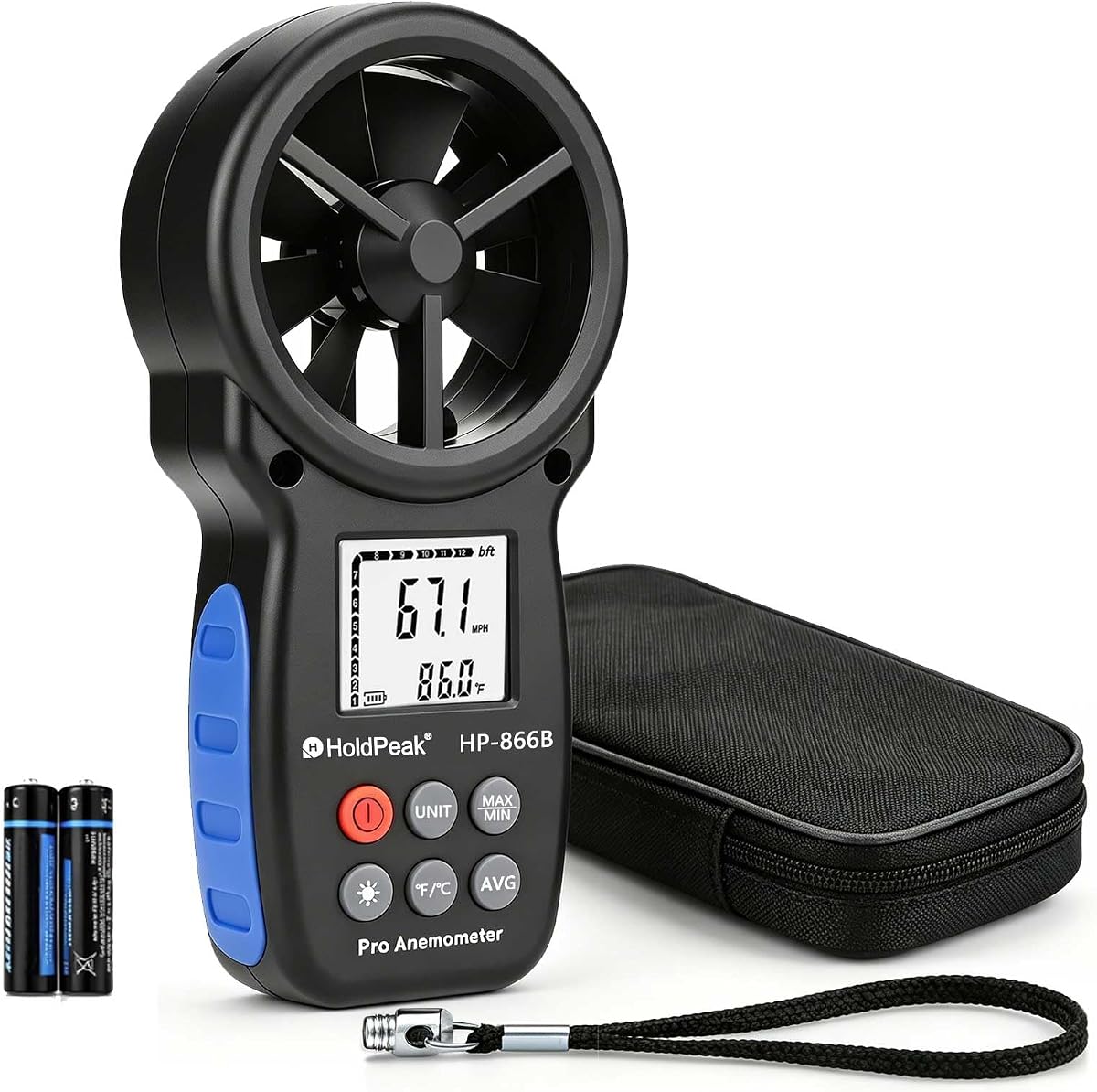
The HoldPeak 866B is tailored for professionals who need to calculate airflow in CFM for duct vents and HVAC systems. Its sensitivity to low air flow makes it a reliable tool for technical inspections and maintenance tasks.
We may earn a commission when you buy through this link, at no additional cost to you.
Equipped with dual temperature sensors and eight vanes it delivers precise data even in challenging environments. The hand strap and waterproof carrying pouch add practical benefits that protect the device and prevent accidental drops.
The unit is slightly heavier than some competitors which may cause fatigue during extended handheld use but offers a solid feel. Users should also ensure they have compatible batteries as the included ones may need replacement over time.
Ideal for technicians and engineers this anemometer bridges the gap between casual use and industrial requirements. Its focus on accuracy and durability makes it a trusted choice for HVAC and airflow measurement applications.
The device calculates CFM by combining wind speed with duct cross-sectional area for accurate system diagnostics.
A hand strap and waterproof pouch protect the unit during transport ensuring longevity and operational safety.
We may earn a commission when you buy through this link, at no additional cost to you.
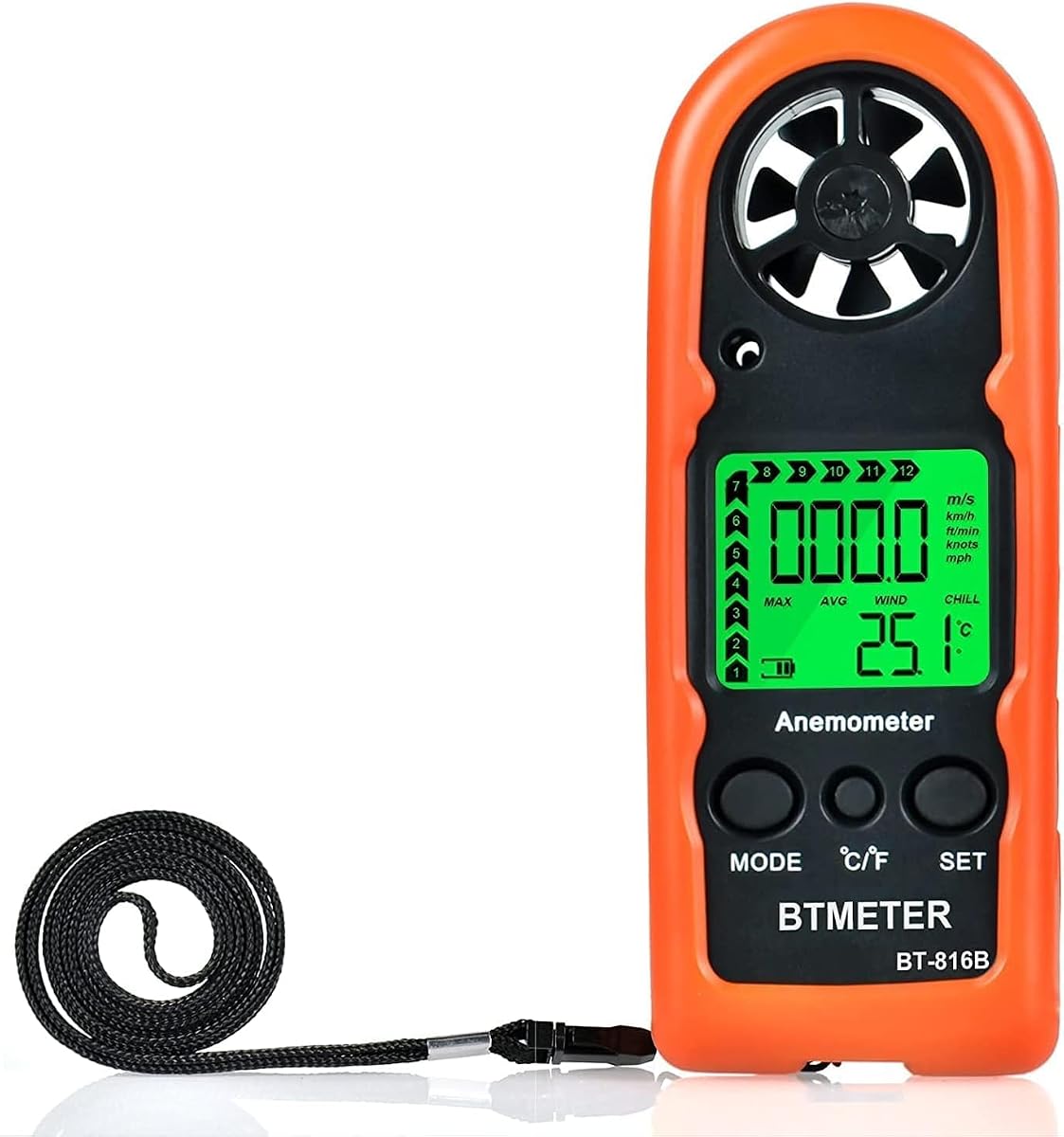
The BTMETER BT-816B is one of the lightest options available weighing only 53 grams making it ideal for hikers and travelers. Its compact design ensures it fits easily in any pocket without adding bulk to your gear.
We may earn a commission when you buy through this link, at no additional cost to you.
Users can enjoy real-time wind chill readings which are essential for outdoor safety and activity planning. The device includes a lanyard to keep it secure around the neck or wrist during active use.
While it lacks some advanced features like tripod holes or humidity sensors it excels at providing quick accurate wind speed and temperature data. The backlight helps with low-light visibility though the screen size is modest.
This model is best suited for those who prioritize weight and size over extensive functionality. It is a great backup or primary device for casual outdoor activities where portability is key.
Weighing just 53 grams the device offers minimal impact on your pack weight during long hiking or climbing trips.
Real-time wind chill indicators help you assess cold stress risk during outdoor activities immediately.
We may earn a commission when you buy through this link, at no additional cost to you.
The Soonkoda 3 in 1 is marketed for a wide range of industries including aviation petrochemical and duct ventilation systems. It provides essential metrics like wind speed temperature and level with a straightforward user interface.
We may earn a commission when you buy through this link, at no additional cost to you.
Its dual-line LCD display allows simultaneous viewing of wind speed and temperature which streamlines the measurement process. The device also includes a backlight and auto power off function to extend battery life during field work.
The build quality is functional but basic and it does not come with a protective case which might be a concern for rugged environments. Users may need to provide their own storage solution to ensure device safety.
This unit is a practical choice for professionals needing a reliable and affordable tool for routine checks. It balances essential features with affordability making it suitable for daily industrial monitoring tasks.
The device is designed to meet needs in sectors like petrochemical aviation and underground warehouse management.
Simultaneous display of wind speed and temperature allows for quick decision-making without toggling screens.
We may earn a commission when you buy through this link, at no additional cost to you.
The AEM01S from POROMETISTO distinguishes itself with a unique color-coded alarm system that instantly communicates safety levels through green orange and red lights. This feature is particularly useful for workers needing rapid safety alerts without reading numbers.
We may earn a commission when you buy through this link, at no additional cost to you.
Sampling occurs every 0.5 seconds providing near real-time data that captures sudden gusts or changes in wind conditions. The ergonomic housing ensures a comfortable grip during extended use which reduces hand fatigue in field operations.
While the color alerts are helpful users must understand the threshold settings to interpret the alarms correctly. The manual may require some study to fully utilize the MAX and backlight functions effectively.
Ideal for construction or outdoor safety monitoring this model offers a proactive approach to wind hazard management. The one-year warranty adds peace of mind for buyers investing in safety-oriented equipment.
The three-color alarm system uses green orange and red lights to indicate safe caution and danger levels clearly.
Data is sampled every 0.5 seconds ensuring you capture rapid wind changes that slower devices might miss.
We may earn a commission when you buy through this link, at no additional cost to you.
The Caldwell Wind Wizard II is engineered specifically for shooters and hunters who require precise wind data to adjust their aim. Its durable construction and clear backlight ensure reliable performance even in adverse weather conditions.
We may earn a commission when you buy through this link, at no additional cost to you.
The non-slip rubber casing provides a secure grip which is essential when holding the device steadily during outdoor use. Users benefit from a limited lifetime warranty that reflects the brand's confidence in product durability.
While effective for its intended purpose it may be overly specialized for users who need broader environmental data. The price point is higher than budget options but justified by the warranty and targeted design.
This model is the top choice for long-range shooting enthusiasts who demand reliability and accuracy. Its focus on shooter needs makes it a standout in the niche market of wind meters for firearms.
Optimized for long-range shooting the device provides precise wind data to adjust bullet trajectory effectively.
The water resistant casing and limited lifetime warranty ensure long-term reliability for field conditions.
We may earn a commission when you buy through this link, at no additional cost to you.
The Proster Digital Anemometer excels in its ability to calculate CFM CMM and CMS values making it valuable for ventilation professionals. It offers five different wind speed units to accommodate various regional standards effortlessly.
We may earn a commission when you buy through this link, at no additional cost to you.
A reading hold feature allows users to capture and view data after removing the device from the airflow which is practical for reporting. The large backlight display ensures that values are easily readable in dark environments like ducts.
The device runs on a 9V battery which is less common than AAA batteries requiring specific replacements when depleted. Its size is slightly bulkier than palm-sized models which might reduce portability for casual users.
This model is best suited for HVAC technicians and engineers who need detailed airflow calculations. The comprehensive measurement options and large screen make it a practical tool for professional diagnostics and maintenance.
Direct CFM CMM and CMS measurements streamline ventilation assessments without external calculation tools.
The reading hold function lets you capture a value for later review after moving away from the measurement point.
We may earn a commission when you buy through this link, at no additional cost to you.
The VEVOR Split Handheld Anemometer stands out with its advanced features including USB data transfer and an extendable cord for flexible measurements. It combines wind velocity temperature air flow and wind chill into one comprehensive device.
We may earn a commission when you buy through this link, at no additional cost to you.
Users can manage their data on a PC for further analysis which is useful for research or professional reporting. The IP44 waterproof rating ensures reliable performance in light rain or snow without worrying about moisture damage.
The split design with a separate vane unit adds some complexity to setup and transport. Additionally the higher price point reflects the advanced capabilities and may not be necessary for casual users.
This model is ideal for professionals and researchers who need detailed data management and durability. Its extensive feature set makes it a robust solution for demanding industrial or outdoor environments.
A USB port allows connection to a PC to store and analyze wind data for detailed reporting.
The IP44 waterproof rating protects the device against rain and snow ensuring reliability in harsh conditions.
We may earn a commission when you buy through this link, at no additional cost to you.
Choosing the right anemometer involves considering your specific needs such as accuracy required measurement units and additional features like temperature or humidity sensors.
Ensure the device supports the units you need such as mph km/h m/s or knots. Different industries use different standards so flexibility is key for broader usability.
Look for models that allow quick switching between units to avoid manual conversion errors during fieldwork.
Check the accuracy rating which is often given as a percentage of the reading. Higher accuracy is crucial for professional applications like HVAC or research.
Select a model with a speed range that matches your typical environment. For extreme weather look for devices capable of measuring high speeds.
Features like temperature humidity or wind chill can add value depending on your activities. These are especially useful for outdoor safety or detailed weather monitoring.
Some models offer CFM calculations or data logging which are essential for technical professionals needing detailed airflow analysis.
A large backlight screen ensures you can read values easily in bright sunlight or low-light conditions. This is important for quick decision-making in varied environments.
Consider devices with color-coded alarms or hold functions if you need to capture data after removing the device from the wind source.
Waterproof ratings and protective carrying cases help ensure the device survives outdoor or industrial environments. A sturdy build reduces the risk of damage from drops or moisture.
Look for ergonomic designs that prevent hand fatigue during extended use especially if you hold the device for long periods.
Models with auto power-off features help conserve battery life during periods of inactivity. This ensures the device is ready when you need it.
Check the type of batteries required such as AAA or 9V and whether they are included. Easy availability of replacements is a practical consideration.
Premium models may offer USB ports for data transfer to a PC. This is useful for logging and analyzing wind data over time.
Connectivity options allow you to integrate the device into broader systems or software for professional reporting and research.
Balance the cost against the features you need. Budget models may suffice for casual use while professionals might need advanced capabilities.
Warranties and customer support options provide peace of mind. A longer warranty period indicates confidence in product durability.
To start ensure the device has fresh batteries and is turned on. Most models have a dedicated power button or auto-activation feature when lifted.
Hold the anemometer in an open area away from obstacles that could interfere with wind flow. Ensure the sensor vanes or blades are aligned with the wind direction for accurate readings.
After use wipe the device with a dry cloth and store it in its carrying case. Regular calibration and checking battery life will keep the device performing accurately over time.
The ideal range depends on your needs. Most handheld models cover 0.5 to 67 mph which is sufficient for most outdoor and industrial activities. Check specifications to ensure it meets your specific environmental demands.
A tripod is useful for long-term monitoring or when your hands are occupied. It provides stability that prevents shaking and ensures consistent data collection over time.
Accuracy typically ranges from ±2% to ±5% of the reading. Professional models often offer better precision while budget options are sufficient for casual use and general monitoring.
Many modern anemometers have waterproof ratings like IP44 which allow use in light rain. However always check the specific rating to ensure protection against moisture for your intended conditions.
Some models include humidity sensors while others do not. If humidity tracking is important for your activities choose a unit that explicitly lists this feature in its specifications.
Store the device in a dry place and wipe it clean after each use. Check the vanes for debris and replace batteries regularly to maintain accuracy and functionality.
The BTMETER BT-100 offers an excellent balance of features and affordability making it our top overall pick. It provides essential tools for both professionals and outdoor enthusiasts without unnecessary complexity.
Consider your specific needs such as the need for humidity tracking or data management when selecting a model. Prioritize accuracy and durability if you work in demanding environments regularly.
Remember to check current listings for any changes in pricing or availability before purchasing. This guide serves as a starting point to help you find the right wind meter for your activities.