
1/2" Flow Hall Sensor
4.7Editor score
NPT Thread connection
Low cost solution
1-30L/min range
Finding the right Arduino Flow Meter is essential for any project involving fluid measurement or control. Whether you are building a smart irrigation system or monitoring water usage, a reliable sensor ensures accuracy and efficiency in your DIY endeavors.
We evaluated ten top-rated models based on user feedback, technical specifications, and compatibility with common microcontrollers like Arduino and Raspberry Pi. Each product was assessed for build quality, flow range, and ease of integration into existing circuits.
This guide details the strengths and weaknesses of every pick to help you make an informed decision. Note that availability and pricing may fluctuate over time, so always check the latest product listings before purchasing your next component.
4.7Editor score

5.0Editor score

5.0Editor score
As an Amazon Associate we earn from qualifying purchases.
The following table provides a quick side-by-side look at the key specifications for each of the ten models reviewed in this guide. Use this to compare flow ranges, connection types, and voltage requirements at a glance.


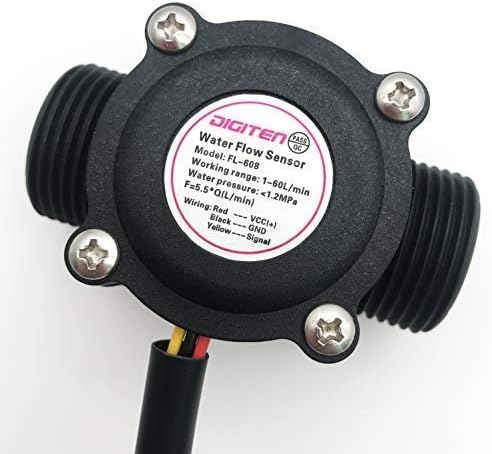
This 1/2 inch flow hall sensor stands out as the best overall choice for hobbyists and professionals alike. It holds an impressive rating from users who appreciate its straightforward design and reliable performance in various settings.
We may earn a commission when you buy through this link, at no additional cost to you.
The sensor features an integrated magnetic hall effect that outputs an electrical pulse with every revolution of the internal impeller. This signal can be easily read by Arduino boards to calculate flow rates accurately.
Users should note that installation requires observing the flow direction indicated on the product. If installed backward, there will be no signal output. However, this is standard for all turbine-based flow meters.
For anyone building a water monitoring system or a smart home project, this sensor offers the best balance of cost and functionality. It is recommended for general-purpose use where high precision is not the primary constraint.
The hall effect sensor is sealed from the water pipe allowing the sensor to stay safe and dry during operation.
It is mainly used in water heaters coffee machines water purifiers and other beverage machinery.
We may earn a commission when you buy through this link, at no additional cost to you.
The DEVMO model is a highly rated budget option ideal for water testing and cooling systems. It provides strong amplitude signals which make it easier to detect pulses on standard microcontroller inputs without complex amplification.
We may earn a commission when you buy through this link, at no additional cost to you.
Its high amplitude is greater than 4.6 volts and low amplitude less than 0.5 volts ensuring clear digital signals. This feature is particularly useful when interfacing with lower sensitivity inputs.
The electric strength rating allows it to handle significant voltage spikes which increases its durability in industrial or outdoor environments. This robustness contributes to its high customer satisfaction score.
If you are working on a project where cost is a major factor but you still need reliable data, this sensor is an excellent choice. It is suitable for applications like credit card machines and vending units.
The high amplitude signal ensures your microcontroller can read flow data without extra components.
Withstanding 1250V electrical strength this sensor is built to last in demanding environments.
We may earn a commission when you buy through this link, at no additional cost to you.
This DIGITEN sensor is the top pick for projects requiring high flow rates up to 150 liters per minute. It holds a perfect rating from users who value its premium build quality and consistent performance.
We may earn a commission when you buy through this link, at no additional cost to you.
The G1.5 inch BSPT male thread connects to larger piping systems making it suitable for main line water monitoring. It is designed to handle pressure up to 1.75 Mpa which covers most residential needs.
Materials are aligned with ROHS testing standards ensuring the sensor is safe for potable water use. This certification is crucial for projects involving drinking water or food processing systems.
Investing in this premium unit is worthwhile for professional applications or when reliability is non-negotiable. It works seamlessly with Arduino and Raspberry Pi for automated flow control systems.
All materials align with ROHS standards so the sensor is safe for drinking water applications.
Supporting flow from 5 to 150L/min this sensor handles everything from slow drips to high volumes.
We may earn a commission when you buy through this link, at no additional cost to you.
This sensor is specifically designed with food-grade materials making it safe for use in drinking water systems or beverage dispensers. Users appreciate its compliance with health standards for water contact.
We may earn a commission when you buy through this link, at no additional cost to you.
The raw materials conform to the ROHS test standard ensuring the product is free from harmful substances. This makes it a responsible choice for projects that prioritize environmental and health safety.
It operates over a wide voltage range from 5 to 24 volts providing flexibility in power source selection. You can power it directly from a 12V supply or use standard 5V logic.
For projects involving coffee machines or drinking fountains this sensor is a reliable choice. Its food grade certification adds peace of mind when monitoring water that might be consumed.
The sensor meets ROHS testing standards which means it is free from hazardous materials.
Working voltage DC 5-24V allows easy integration into various power systems.
We may earn a commission when you buy through this link, at no additional cost to you.
This pack includes two transparent flow sensors which is a great value for testing multiple projects. The transparent body allows you to visually observe water flow and rotor conditions directly.
We may earn a commission when you buy through this link, at no additional cost to you.
The impeller is internally inlaid with stainless steel beads which improves wear resistance. This design choice helps extend the life of the sensor even with abrasive water types.
Users can observe the flow state to quickly identify air locks or blockages without using a multimeter. This visual feedback is helpful for debugging flow issues in real time.
If you are prototyping or need a backup sensor for redundancy this pack is an excellent choice. The transparent design offers unique insights into the internal mechanics.
The transparent body facilitates observation of water flow and rotor conditions at a glance.
Stainless steel beads in the impeller ensure the rotor survives long term use.
We may earn a commission when you buy through this link, at no additional cost to you.
This sensor is ideal for low flow applications such as small hosepipes or tubing connections. It fits hosepipes with an inner diameter of about 5 to 7mm which is common in drip irrigation.
We may earn a commission when you buy through this link, at no additional cost to you.
The flow range starts as low as 0.3 liters per minute making it sensitive enough to detect leaks or very slow drips. This sensitivity is useful for conservation projects.
It is made from food grade plastic and conforms to the ROHS test standard. This ensures safety in environments where water quality is important.
Use this model when your system operates at lower pressures up to 0.8Mpa. It is perfect for delicate setups like plant watering systems or small pumps.
The range 0.3-6L/min makes it perfect for detecting slow leaks or drips.
Connects to a hosepipe whose inner diameter is about 5 to 7 mm.
We may earn a commission when you buy through this link, at no additional cost to you.
This model is specifically designed for detecting influent flow rate at the water inlet end of heaters. It provides the necessary feedback to controllers to regulate flow and ensure safety.
We may earn a commission when you buy through this link, at no additional cost to you.
The magnetic rotor rotates and the rotational speed changes with the flow rate change. The Hall sensor outputs a corresponding pulse signal that is accurate and reliable.
It is perfect for automatic water dispensers where flow needs to be measured precisely before dispensing. The pulse signal can be fed back to any standard controller.
Users appreciate the perfect rating which reflects consistent performance. If you are integrating into a heater or dispenser this is a trusted solution.
The Hall sensor outputs a corresponding pulse signal and feeds it back to the controller.
It is installed at the water inlet end to detect flow as it passes through.
We may earn a commission when you buy through this link, at no additional cost to you.
This version comes with a 1.2 meter cable which eliminates the need for extra connectors or soldering. This convenience is highly valued by users who install sensors in tight spaces.
We may earn a commission when you buy through this link, at no additional cost to you.
The cable length allows you to place the sensor on the pipe while keeping the electronics in a dry safe box. This separation is crucial for protecting your Arduino from moisture.
The connector type is SM2.54 3P which is standard and easy to plug into headers. The sensor is waterproof and heat resistant for reliable operation.
If you prefer a plug-and-play solution this model is ideal. It works for Arduino and Raspberry Pi and is compatible with reverse osmosis filters.
The cable allows you to place the sensor on the pipe while keeping electronics dry.
Wire connector type SM2.54 3P makes it easy to integrate into your circuit.
We may earn a commission when you buy through this link, at no additional cost to you.
This sensor features a G3/8 inch thread making it perfect for smaller plumbing applications. It supports low voltage from 3.5 to 12 volts which is common in portable projects.
We may earn a commission when you buy through this link, at no additional cost to you.
The flow range of 0.3 to 10 liters per minute is suitable for applications that do not require high throughput. It provides a square wave output for easy pulse counting.
The small size and easy installation make it a popular choice for compact water systems. All materials are in line with ROHS testing standards.
Use this model for small tanks or specific appliances where size and voltage matter. It is a reliable option for low voltage systems.
Working voltage range DC 3.5-12 V suits portable or battery powered systems.
Small size and easy to install all materials are in line with ROHS testing standards.
We may earn a commission when you buy through this link, at no additional cost to you.
This unit handles a higher flow rate up to 60 liters per minute making it suitable for larger pipes. It includes a 1.2 meter cable for flexible installation.
We may earn a commission when you buy through this link, at no additional cost to you.
The G3/4 inch BSPT male thread connects to standard larger plumbing pipes. It is compatible with Arduino and Raspberry Pi for advanced monitoring.
The waterproof design and cold resistance make it reliable for various environmental conditions. The output signal is a square wave pulse.
Use this sensor when you need to monitor high volume flow such as in industrial or main line water systems. The cable length offers installation convenience.
Flow range 1-60L/min handles larger volume applications effectively.
Small size waterproof easy to install heat and cold resistance.
We may earn a commission when you buy through this link, at no additional cost to you.
Selecting the right flow sensor involves balancing technical needs with environmental factors. This guide breaks down the key attributes to consider before buying.
The flow rate range defines the minimum and maximum volume of water the sensor can accurately measure. If your project involves slow drips look for a range starting near 0.3L/min. For high volume main lines you will need a sensor supporting 60L/min or more.
Always match the sensor to your typical operating flow to ensure accurate readings.
Sensors come with various thread sizes like G1/2, G3/4, or NPT. Check your plumbing pipes to ensure the sensor fits directly or if you need an adapter. A mismatch in threads can cause leaks or poor flow.
Verify the thread size on your pipes before purchasing to save time on installation.
Most Arduino sensors run on DC 5V but some support up to 24V. Ensure your power supply matches the sensor requirements. Higher voltage options may be useful if you are powering multiple sensors from a single supply.
Stick to the recommended voltage to avoid damaging the sensor electronics.
If you are measuring drinking water ensure the sensor is made of food grade materials. Look for ROHS compliance which ensures no hazardous materials are used. Plastic is standard but some models offer better resistance to chemicals.
Choose food grade materials for any potable water application.
A built in cable helps separate the sensor from your electronics which protects them from moisture. A 1.2 meter cable is usually sufficient for most setups. If you are in a tight space a shorter sensor body may be preferred.
Long cables allow you to place the electronics in a safer drier location.
Check the maximum pressure rating to ensure the sensor won't burst under high pressure. Most models handle up to 1.75 Mpa which covers residential needs. For industrial high pressure systems look for reinforced models.
Verify the pressure rating to prevent leaks or damage in your system.
Ensure the sensor is compatible with your microcontroller like Arduino or Raspberry Pi. The Hall Effect output is a square wave signal which is easy to read with interrupt pins on most boards.
Check the output signal type to ensure it works with your code and board.
Standard sensors are often designed for cold water only. If you are measuring hot water from a heater verify that the sensor can withstand heat. Some models are specifically rated for water heaters.
Use heat resistant models for any system involving hot liquids.
Start by connecting the VCC pin to 5V on your Arduino and the GND to ground. Connect the signal pin to a digital interrupt pin to accurately capture the flow pulses.
Install the sensor on the pipe ensuring the flow arrow points in the direction of the water. Use Teflon tape on the threads to prevent leaks during operation.
Regularly check the sensor for debris that might block the impeller. If accuracy drops clean the internal turbine and ensure the water is free from large particles.
A Hall Effect sensor detects the rotation of a magnetized impeller. As water flows the impeller spins and the sensor outputs a pulse for each rotation. This allows the Arduino to calculate the flow rate accurately.
Most standard sensors are designed for cold water. If you need to measure hot water look for a model specifically rated for water heaters. Using a cold sensor with hot water may damage the internal components.
Each revolution corresponds to a known volume of water usually around 0.015 liters. Count the pulses over a set time and divide by the pulses per liter to get the flow rate in liters per minute.
Many models are made with food grade materials and are ROHS compliant. Always check the product description to confirm if the specific unit is safe for potable water before using it with drinking supplies.
Most Arduino flow meters operate on 5V DC. However some models support a wider range up to 24V. Check the datasheet for your specific sensor to ensure you provide the correct voltage.
The sensor can be powered directly from the Arduino board for small projects. For larger setups or multiple sensors use a dedicated 5V power supply to ensure stable readings and prevent brownouts.
We reviewed ten top Arduino Flow Meter models ranging from budget options to premium high flow sensors. The DIGITEN G1.5 and the 1/2 flow Hall sensors offer excellent value for most hobbyists.
Consider your flow range and pressure needs first before checking voltage compatibility. Always ensure you choose a food grade model if the water is meant for drinking.
Prices and availability change frequently so check current listings before you buy. We hope this guide helps you select the right component for your next water project.