
ESP32-P4-NANO Development Board
4.8Editor score
RISC-V Dual-Core Architecture
MIPI-CSI and DSI Interfaces
32MB PSRAM Included
Explore the top 10 Arduino Nano ESP32 boards for IoT and embedded projects. Compare features, wireless connectivity, ratings, and performance to find the right microcontroller for your next build.
The Arduino Nano ESP32 represents a significant leap in microcontroller technology, blending the familiar form factor of the Nano series with the powerful capabilities of the ESP32-S3 chip. This combination offers developers robust wireless connectivity, advanced processing power, and compatibility with popular programming environments like Arduino IDE and MicroPython.
In this guide, we have carefully evaluated ten distinct boards that fit within this category or offer similar capabilities. We compared their processor specs, wireless features, memory capacities, and overall user ratings to determine which options stand out for reliability and performance in real-world applications.
Each pick below highlights specific strengths tailored to different project needs, from compact wearables to complex IoT systems. While product availability and pricing can fluctuate over time, the core technical specifications and community ratings remain consistent indicators of quality for your development journey.
4.8Editor score

4.6Editor score

5.0Editor score
This side-by-side comparison highlights the key technical specifications of each board to help you quickly identify the right match for your specific project requirements and budget constraints.


The Arduino Nano ESP32 stands out as a top choice for makers seeking a modern microcontroller experience. Its rating reflects a strong community consensus on its reliability and ease of use. The standout qualities include its full support for the ESP32-S3 chipset, offering both robust processing and versatile wireless options in a compact form factor.
We may earn a commission when you buy through this link, at no additional cost to you.
Key strengths lie in its comprehensive wireless connectivity, including Wi-Fi and Bluetooth 5.0, which simplifies IoT integrations. The inclusion of HID support allows for unique projects like custom keyboards or mice without needing external chips. Additionally, MicroPython compatibility opens the board to a wider range of developers who prefer Python over C++ for rapid prototyping.
Honest trade-offs include a price point that might be slightly higher than generic ESP32 clones. However, the official Arduino quality assurance, pre-soldered headers, and robust software ecosystem often justify this premium for professional and educational projects where reliability is paramount.
If you value official support, modern standards like USB-C, and easy access to libraries, this board is the ideal pick. It is perfect for smart home devices, wearables, and educational kits that need to be plug-and-play ready for students and hobbyists.
The board supports both Wi-Fi and Bluetooth 5.0 for seamless communication with networks and devices.
MicroPython compatibility makes rapid development and educational projects significantly easier for beginners.
We may earn a commission when you buy through this link, at no additional cost to you.
The ESP32-P4-NANO Development Board represents the high-end of this category, focusing on performance-intensive tasks. With a rating of 4.8, it appeals to advanced users needing raw power. Its standout feature is the RISC-V dual-core architecture paired with massive memory capacity, enabling complex image and voice processing right on the edge.
We may earn a commission when you buy through this link, at no additional cost to you.
Detailed strengths include the inclusion of MIPI-CSI and MIPI-DSI interfaces, which are rare on development boards and crucial for camera and display integration. The 32MB PSRAM and 16MB Flash provide ample room for running complex applications without external storage bottlenecks. Security features like secure boot and flash encryption are also integrated directly into the chip.
Trade-offs involve a steeper learning curve and higher price point compared to standard Arduino Nano boards. The sheer number of interfaces can be overwhelming for simple projects, making it best suited for specialized industrial or multimedia applications where basic boards would fail to deliver sufficient performance.
Professional developers building industrial control systems, robotics, or multimedia kiosks will find this board unmatched. If you need maximum compute power and specialized interfaces in a compact form, this is the premium choice to consider for your next high-performance build.
Built-in JPEG codec and image signal processors allow for sophisticated on-device vision tasks.
Hardware access protection and secure boot mechanisms ensure your deployed projects remain secure.
We may earn a commission when you buy through this link, at no additional cost to you.
The ESP32-S3-Nano Microcontroller Board offers exceptional value, making it a top budget choice for hobbyists. With a perfect 5.0 rating, users praise its performance-to-cost ratio. It integrates the powerful ESP32-S3R8 chip, offering 8MB PSRAM and seamless compatibility with both Arduino IDE and MicroPython environments.
We may earn a commission when you buy through this link, at no additional cost to you.
Key strengths include the generous memory allocation, allowing for larger sketches and data logging without external memory. The support for HID profiles enables unique projects like custom keyboards. Additionally, compatibility with Arduino IoT Cloud simplifies remote monitoring and control, adding enterprise features at a hobbyist price point.
While it lacks the branded packaging of official Arduino boards, the core functionality remains robust. The generic form factor may look less polished, but it gets the job done effectively. Most users find the performance and features far exceed the low price, making it an excellent starter board.
Ideal for students and makers on a tight budget, this board provides all the essential tools for learning IoT development. Whether you are building a smart sensor or a basic automation system, this board delivers the necessary power without breaking the bank.
8MB PSRAM supports complex data tasks and extensive variable storage without external chips.
Supports both C++ and Python to suit different developer preferences and skill levels.
We may earn a commission when you buy through this link, at no additional cost to you.
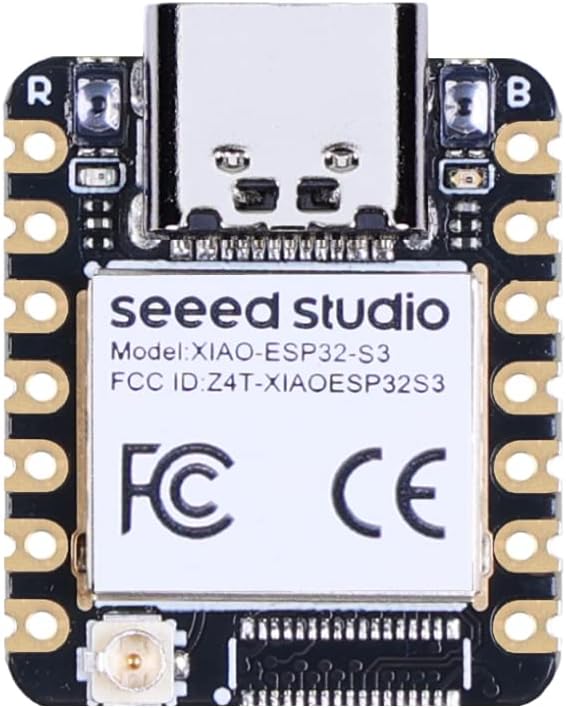
The Seeed Studio XIAO ESP32S3 is specifically designed for projects where space is at a premium. With a rating of 4.7, it is highly regarded for its battery management features. The thumb-sized design allows it to fit comfortably inside wrist-worn devices or small enclosures where larger boards would not.
We may earn a commission when you buy through this link, at no additional cost to you.
Its strengths include lithium battery charge management capabilities, which simplify power supply design for portable projects. The board supports deep sleep modes with consumption as low as 14 microamps, extending battery life significantly. The RF performance is also optimized to support remote communication over significant distances with external antennas.
Trade-offs include the small form factor which can make soldering difficult for beginners. However, the breadboard-friendly pins allow for easy prototyping without soldering. Most users find the size trade-off worth the massive benefit of portability and power efficiency in their wearable or sensor projects.
This board is perfect for portable health monitors, location trackers, or interactive toys. If your project needs to be small, lightweight, and long-lasting on battery power, the XIAO ESP32S3 provides the necessary efficiency in a tiny package.
Optimized power design supports deep sleep modes for long-term deployment in remote sensors.
The 21mm x 17mm size makes it ideal for wearable devices with tight space constraints.
We may earn a commission when you buy through this link, at no additional cost to you.
The Waveshare 3PCS ESP32-S3 Mini Development Board offers excellent value by providing three units in a single package. With a rating of 4.4, it is appreciated by users who need multiple nodes for mesh networks or sensor arrays. The boards are built around the reliable ESP32-S3FH4R2 chip with 4MB Flash memory.
We may earn a commission when you buy through this link, at no additional cost to you.
Key strengths include the castellated module design which allows these boards to be soldered directly onto carrier boards. This feature is particularly useful for custom hardware designs where a standard USB connector is not needed. Independent power supply settings allow for flexible power management across different project scenarios.
Trade-offs involve the lack of an integrated USB connector, meaning you need an external serial adapter for programming and power. While this adds a slight complexity for prototyping, it benefits custom PCB designs by reducing the board footprint significantly for embedded final products.
Ideal for developers creating sensor networks or custom hardware modules, this pack provides the quantity needed for testing and deployment. If you plan to integrate ESP32 functionality into a larger custom system, these standalone modules are a convenient and cost-effective solution.
Castellated edges allow direct surface-mount soldering for custom PCB carrier boards.
Getting three boards in one pack saves time when testing multi-node IoT setups.
We may earn a commission when you buy through this link, at no additional cost to you.
The ELEGOO ESP-32 Super Starter Kit is designed for those new to electronics and IoT. With a rating of 4.3, it is praised for its educational value. The kit includes over 35 different modules and components, providing everything needed to explore a vast range of projects from a single box.
We may earn a commission when you buy through this link, at no additional cost to you.
Strengths include the step-by-step online tutorials that accompany the hardware. These resources include clear circuit diagrams and code examples that guide users through fundamental electronics and coding concepts. This approach helps students and hobbyists build confidence without getting lost in technical manuals.
Trade-offs involve the use of an older Bluetooth 4.2 standard instead of BLE 5.0 or Wi-Fi on some parts. However, for learning purposes, the core ESP-32 capabilities are sufficient. The sheer volume of components might initially seem overwhelming, but the organized tutorials mitigate this issue effectively.
This kit is perfect for students, teachers, or absolute beginners looking to learn IoT without buying parts individually. It serves as an excellent foundation for understanding sensors, motors, and displays, setting you up for more advanced custom projects later on.
Detailed tutorials provide clear instructions and code for 30+ beginner-friendly projects.
Access to over 35 modules ensures you have everything needed for diverse experiments.
We may earn a commission when you buy through this link, at no additional cost to you.
The Arduino Nano 33 IoT brings a focus on security to the Nano series. With a rating of 4.5, it is trusted for applications where data integrity is crucial. It features a built-in secure element that enhances project security through hardware-level encryption for cloud communications.
We may earn a commission when you buy through this link, at no additional cost to you.
Key strengths include the integration of a u-blox Secure Element and onboard IMU sensors, which reduce the need for external components. The WiFi and Bluetooth connectivity is reliable and well-supported by the official Arduino IoT Cloud platform. This makes it a solid choice for industrial monitoring or secure home automation.
Trade-offs involve a slower processor compared to newer ESP32 variants. However, for most IoT tasks involving data transmission and control, the performance is adequate. The premium price reflects the official support and advanced security features that are hard to replicate with standard microcontrollers.
If your project involves sensitive data or secure cloud connections, this board is the safest choice. It is ideal for developers who prioritize security and official documentation over raw computational speed in their wireless IoT deployments.
The Secure Element ensures encrypted communication and data privacy for IoT deployments.
Full support from the Arduino IDE and official libraries simplifies development and debugging.
We may earn a commission when you buy through this link, at no additional cost to you.
The ESP-WROOM-32 ESP32 Board is a classic choice for developers familiar with the original ESP32 architecture. With a rating of 4.4, it remains popular for its stability and extensive community support. The board integrates a powerful dual-core processor with Wi-Fi and Bluetooth 4.2 capabilities.
We may earn a commission when you buy through this link, at no additional cost to you.
Its strengths include support for three modes: AP, STA, and AP+STA, offering flexibility in network configuration. The low power consumption makes it suitable for battery-powered projects. Additionally, receiving three units in a pack provides significant value for prototyping multiple nodes or backups.
Trade-offs include the older Bluetooth 4.2 standard which lacks the efficiency of BLE 5.0 found in newer chips. While sufficient for many projects, it may not be the best choice for low-power battery devices that rely heavily on Bluetooth scanning or beacons.
If you are working on established projects or prefer the stability of the classic ESP32, this board is reliable. It is a good fit for general-purpose IoT applications where the latest Bluetooth standards are not a strict requirement.
Support for AP, STA, and combined modes simplifies creating flexible network architectures.
Getting three boards in one order is excellent for projects requiring multiple connected devices.
We may earn a commission when you buy through this link, at no additional cost to you.
The ELEGOO 3PCS ESP-32 Dev Boards offer a modern update to the classic ESP32 with a USB-C port. With a rating of 4.7, users appreciate the convenience of USB-C for power and programming. Each board features a CP2102 chip which ensures reliable serial communication with computers.
We may earn a commission when you buy through this link, at no additional cost to you.
Strengths include support for Over-the-Air (OTA) updates, allowing firmware changes without physical connection. This is a massive benefit for deployed devices that are hard to reach. The dual-core performance allows for responsive embedded and IoT tasks suitable for a wide range of applications.
Trade-offs include the continued use of Bluetooth 4.2 which is less energy-efficient than BLE 5.0. However, the USB-C convenience often outweighs this for wired development workflows. Most users find the build quality to be solid given the affordable price point for a three-pack.
This option is perfect for students or hobbyists needing multiple boards for class projects. The combination of modern USB-C connectivity and OTA support makes it a practical choice for intermediate IoT development where convenience and flexibility are valued.
The USB-C port simplifies power delivery and programming connections for modern setups.
OTA support allows updating deployed devices via WiFi without needing USB cables.
We may earn a commission when you buy through this link, at no additional cost to you.
The Arduino UNO R4 WiFi combines two powerful chips to deliver advanced capabilities. With a rating of 4.7, it is highly regarded for its unique features. The board pairs a Renesas RA4M1 with an ESP32-S3, offering both high-speed communications and real-time data processing capabilities.
We may earn a commission when you buy through this link, at no additional cost to you.
Its strengths include a built-in 12×8 LED matrix for instant visual feedback without external displays. The inclusion of CAN bus support makes it suitable for automotive or industrial systems. High-precision 12-bit DAC and OP-AMP allow for detailed analog signal control which is rare on standard boards.
Trade-offs involve a larger size compared to Nano boards and a higher price tag. However, the integration of these advanced features often eliminates the need for external breakout boards or shields, saving time and wiring effort in complex systems.
Ideal for advanced IoT projects needing high-precision analog output or industrial communication standards, this board is a versatile powerhouse. It is perfect for robotics, automation controllers, or interactive displays that require a blend of power and ease of use.
The 12×8 LED matrix allows displaying status or messages directly on the board.
CAN bus support enables reliable real-time communication for automotive and robotic systems.
We may earn a commission when you buy through this link, at no additional cost to you.
Choosing the right microcontroller requires understanding the specific demands of your project. Here are key factors to consider when selecting a board.
The core processor dictates how fast your board can run code and handle data. Modern ESP32-S3 chips often run at 240 MHz and offer dual cores, which is excellent for multitasking in IoT applications. For complex tasks like image processing, RISC-V options provide even higher performance.
Look for boards that match your computational needs; high speeds are vital for real-time processing while basic sensors work fine with standard speeds.
Wireless capabilities are central to most modern projects. Ensure the board supports the specific WiFi and Bluetooth versions you need. Bluetooth 5.0 offers better range and lower power consumption than older versions like 4.2 which is critical for battery-operated devices.
Prioritize BLE 5.0 or WiFi 6 support if your project relies on long battery life or high-speed data transfer over networks.
Memory capacity determines how complex your sketches can be. SRAM is used for variables while Flash stores your code. Boards with more PSRAM are better for handling large data buffers or image processing tasks without crashing.
Choose higher memory options if you plan to store significant data or use libraries that require substantial RAM resources.
Power efficiency is crucial for portable or remote devices. Look for boards that support deep sleep modes with low microamp consumption. Integrated battery charging circuits can simplify your design significantly by removing the need for external chargers.
Opt for boards with built-in power management if your project must run unattended for long periods on a single battery charge.
The physical connector type affects how easily you can connect the board to your computer. USB-C is becoming the standard for faster data transfer and more durable connections. Traditional micro-USB ports are older and less common now.
Select USB-C boards to ensure compatibility with modern cables and accessories which simplifies the development process significantly.
Software support determines how easy it is to find libraries and tutorials. Boards backed by official brands often have better documentation and community forums. Compatibility with popular IDEs like Arduino IDE or MicroPython can drastically reduce your learning curve.
Check if the board supports the programming language you are most comfortable with to speed up your development time.
Some projects require specific hardware interfaces like CAN bus or camera connectors. Boards offering these features reduce the need for external components. Interfaces like MIPI or high-precision DACs are necessary for industrial or multimedia applications.
Identify any specific peripheral needs early to avoid retrofitting extra boards later which adds cost and complexity.
The physical size of the board matters if you have space constraints. Compact boards like the XIAO series are ideal for wearables while larger boards offer more space for soldering. Consider the size of your final enclosure when choosing a board.
Balance the need for small size with the practical requirements of wiring and soldering in your specific project case.
Start by installing the Arduino IDE or your preferred development environment on your computer. Select the correct board type from the tools menu to ensure the software uploads code correctly. Connect your board via USB to power it and establish a serial link for debugging.
When working with wireless features, ensure you have the correct drivers installed for the USB chip. Test your WiFi or Bluetooth connectivity using simple example sketches before moving to complex code. This helps verify that the radio hardware is functioning properly without logic errors.
Protect your board from moisture and excessive dust during operation. Avoid shorting the GPIO pins with exposed metal wires or static electricity. When storing unused boards, keep them in anti-static bags to preserve the electronic components for future use.
Most modern ESP32 boards support MicroPython but you need to flash the firmware first. The Arduino Nano ESP32 has native support for it built directly into the IDE.
The ESP32-S3 focuses on general IoT tasks with AI acceleration while the ESP32-P4 targets high performance image processing with RISC-V cores. The P4 offers more specialized interfaces for screens and cameras.
Yes, the newer ESP32-S3 boards support Bluetooth 5.0 which offers better range and efficiency. Older models might stick to 4.2 which is still functional but less power-efficient.
No, you need a USB-C cable to connect to these newer boards. Using older cables physically will not work as the connector shape is different.
The Seeed Studio XIAO ESP32S3 is excellent for battery projects due to its deep sleep capabilities. The Arduino UNO R4 also has efficient power modes suitable for longer term runs.
Yes, most of these boards are compatible with Arduino IoT Cloud. This allows you to monitor and control your devices from anywhere using their official app.
We reviewed ten outstanding options ranging from compact modules to feature-rich development boards. The Arduino Nano ESP32 stands out as the top overall pick for its balance of power and ease of use.
If you need specialized features like image processing or industrial interfaces, the ESP32-P4-NANO or UNO R4 WiFi provide the necessary capabilities. For budget-conscious projects, the ESP32-S3-Nano offers incredible value without sacrificing core features.
Prices and availability can change quickly so please verify current details before purchasing. Always check the specific technical specifications to ensure the board fits your power and size requirements.