
ASUS Pro WS W890E-SAGE SE
5.0Editor score
Intel Xeon 600 support
NitroPath DRAM technology
USB4 and 20Gbps Type-C
Discover the top 10 ASUS Server Motherboard options. Compare features, ratings, and specs to find the right workstation or server board for your needs.
ASUS server motherboards deliver enterprise-grade reliability for workstations and data centers. These boards support high-core CPUs, ECC memory, and robust connectivity for demanding enterprise workloads.
We evaluated ten models based on chipset support, expansion slots, management features, and thermal design. This list covers everything from compact mATX boards to full E-ATX dual-socket systems.
Each pick highlights key strengths and ideal use cases to help you choose quickly. Product availability and specs may change, so verify details before purchasing your next server platform.
5.0Editor score

3.7Editor score
4.3Editor score
This table compares all ten models side by side. Review socket type, memory capacity, expansion slots, and management tools to match your workload requirements.


The ASUS Pro WS WRX90E-SAGE SE ranks first for its unmatched expansion capability. It supports AMD Ryzen Threadripper PRO 7000 WX-Series processors with up to 96 cores, delivering exceptional compute power for AI, rendering, and virtualization.
We may earn a commission when you buy through this link, at no additional cost to you.
Seven PCIe 5.0 x16 slots provide massive I/O bandwidth, while dual 10Gb LAN ports and four M.2 slots ensure fast storage and networking. The 32-stage power system and active cooling keep performance stable under heavy loads.
Trade-offs include the need for compatible Threadripper PRO CPUs and a large EEB footprint that may not fit smaller cases. These are acceptable given the workstation-class features and IPMI remote management.
Buyers seeking a top-tier workstation for scientific computing or deep learning should prioritize this board. Its combination of PCIe lanes, ECC memory support, and remote management makes it the best all-round choice.
Seven PCIe 5.0 x16 slots enable multiple GPUs, accelerators, and NVMe cards without bandwidth throttling, ideal for GPU clusters or multi-storage arrays.
Dedicated AST2600 BMC with IPMI allows out-of-band monitoring and control, ensuring administrators can manage systems remotely with minimal downtime.
We may earn a commission when you buy through this link, at no additional cost to you.
The ASUS Pro WS W890E-SAGE SE is ideal for Intel-based workstations needing premium features. Designed for the latest AI PCs, it supports Intel Xeon 600 processors with NitroPath DRAM technology for enhanced DDR5 performance.
We may earn a commission when you buy through this link, at no additional cost to you.
Seven PCIe 5.0 x16 slots, dual 10Gb LAN, four M.2 slots, plus USB4 and SlimSAS ensure future-proof connectivity. The active cooling solution covers VRMs, chipsets, and M.2 drives to sustain performance.
While premium-priced and requiring specific CPUs, its feature set justifies the cost for demanding workloads. The combination of advanced DRAM tech and server-grade management supports reliability.
Professionals seeking top-tier Intel workstation performance should choose this model. Its expansion, connectivity, and IPMI tools make it a versatile premium choice.
NitroPath DRAM technology enhances ECC DDR5 performance, delivering faster memory bandwidth for AI training and data processing tasks.
USB4 40Gbps and 20Gbps Type-C ports support high-speed peripherals, while SlimSAS and MCIO provide NVMe and enterprise storage flexibility.
We may earn a commission when you buy through this link, at no additional cost to you.
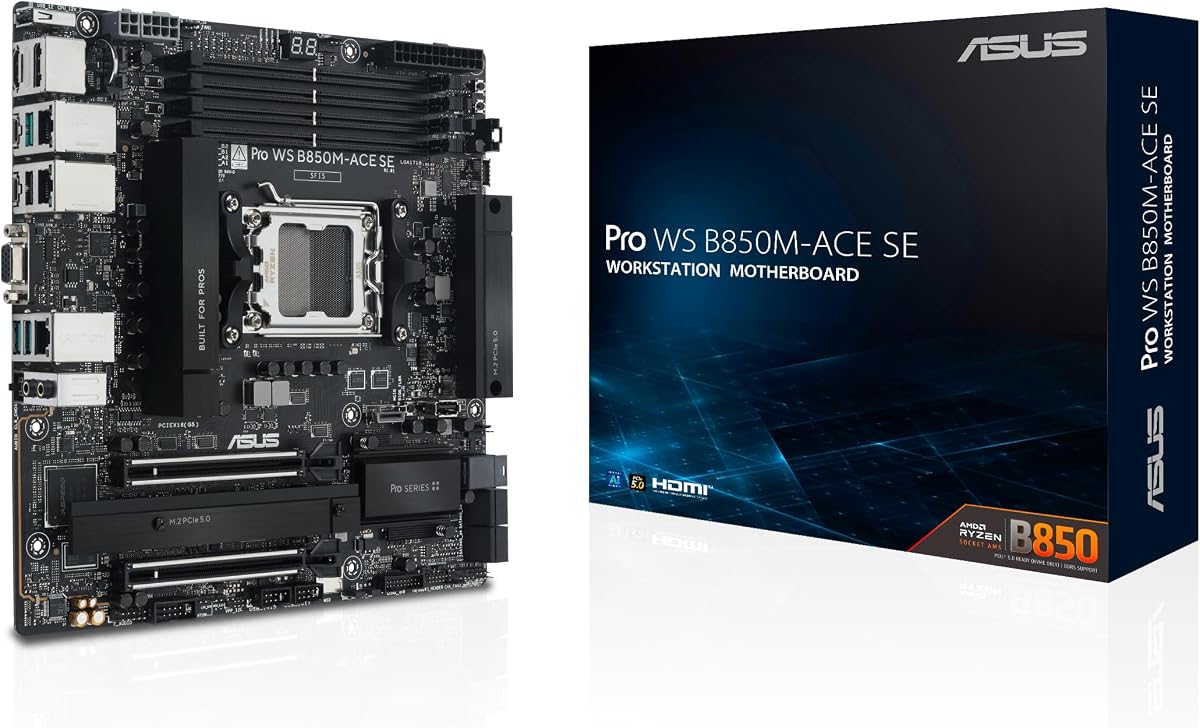
The ASUS Pro WS B850M-ACE SE delivers server features at a budget-friendly mATX size. Compatible with AMD Ryzen 9000/8000/7000 and EPYC 4005 processors, it balances performance and cost for small businesses.
We may earn a commission when you buy through this link, at no additional cost to you.
Onboard BMC AST2600 and ASUS Control Center Express provide IPMI remote management, while dual 10G and 2.5G LAN plus MCIO/U.2 support high-speed storage. PCIe 5.0 and USB4 ensure modern connectivity.
Fewer expansion slots compared to larger boards are a trade-off, but acceptable for entry-level workloads. The compact size and server features make it an efficient starter option.
Business users needing reliable remote management on a budget should consider this model. Its AM5 support and IPMI capabilities offer strong value without compromising core server features.
IPMI remote management and dual high-speed LAN provide enterprise functionality in a compact, cost-effective mATX package ideal for small offices.
Support for Ryzen 9000 and EPYC 4005 ensures compatibility with the latest multi-core CPUs for workloads like virtualization and rendering.
We may earn a commission when you buy through this link, at no additional cost to you.
The ASUS Pro WS TRX50-SAGE WIFI is designed for AMD Threadripper PRO 7000 WX-Series processors with integrated WiFi 7. It supports up to 1TB ECC memory and features 36 power stages for stability.
We may earn a commission when you buy through this link, at no additional cost to you.
Three PCIe 5.0 x16 slots, three M.2 slots, front and rear USB 20Gbps Type-C, and SlimSAS provide robust connectivity. IPMI remote management ensures enterprise-level monitoring and control.
Lower review ratings suggest mixed user experiences, yet its hardware specs remain strong. The inclusion of WiFi 7 is advantageous for environments needing wireless bandwidth alongside wired connections.
Users seeking AMD Threadripper support with advanced wireless options should consider this board. Its multi-GPU and memory capacity suit high-performance computing and content creation.
Integrated WiFi 7 delivers unprecedented wireless throughput, beneficial for systems needing reliable connectivity without additional adapters.
Up to 1TB of ECC R-DIMM DDR5 ensures data integrity and ample memory for large datasets and virtualization workloads.
We may earn a commission when you buy through this link, at no additional cost to you.
The ASUS Pro WS TRX50-SAGE WiFi A supports AMD Ryzen Threadripper 9000 and 7000 WX-Series. It features 20 power stages, four M.2 slots, and two USB4 40Gbps ports for high-speed peripherals.
We may earn a commission when you buy through this link, at no additional cost to you.
Three PCIe 5.0 x16 slots, a PCIe 4.0 x16 slot, and SlimSAS support ensure flexibility. IPMI expansion support and ASUS Control Center Express enable remote monitoring for system administrators.
While not having built-in WiFi 7, the USB4 integration provides excellent wired alternatives. Dual PSU connectors allow redundancy options, enhancing reliability for critical workloads.
Workstation users prioritizing USB4 speeds and Threadripper expansion should select this board. Its feature set balances performance, connectivity, and enterprise management tools.
Two USB4 40Gbps ports enable fast external storage and video output, essential for workflows needing quick data transfers or multi-monitor setups.
Multiple 8-pin CPU/PCIe power connectors support dual PSU operation, improving system stability and uptime for 24/7 environments.
We may earn a commission when you buy through this link, at no additional cost to you.
The ASUS Pro WS W680-ACE IPMI targets Intel 13th and 12th Gen processors with ECC support. It includes an IPMI expansion card and BMC header for remote management, ideal for small business servers.
We may earn a commission when you buy through this link, at no additional cost to you.
Dual PCIe 5.0 Safeslots, three M.2 PCIe 4.0, Thunderbolt 4 header, and dual 2.5Gb LAN provide versatile connectivity. DrMOS and ProCool connectors ensure stable power delivery under load.
While limited to one CPU and fewer PCIe slots, the Thunderbolt 4 integration is valuable for creative workstations. The bundled IPMI card saves additional costs and setup time.
Business users requiring Intel-based reliability with remote management should consider this board. Its balanced I/O and power features make it a solid workstation choice.
Bundled IPMI expansion card enables out-of-band control, helping administrators manage systems remotely for improved uptime and monitoring.
Thunderbolt 4 header supports high-speed external peripherals and docking solutions, expanding flexibility for professional workflows.
We may earn a commission when you buy through this link, at no additional cost to you.
The Asus P12R-M/10G-2T is a compact server motherboard built for Intel Xeon E-2300 processors. Its Micro ATX design suits space-constrained environments while maintaining server-grade reliability.
We may earn a commission when you buy through this link, at no additional cost to you.
The Intel C252 chipset ensures stability, though specific expansion slots and management tools are less detailed. This model fills a niche for budget-conscious small servers.
Older socket limitations mean reduced future upgrade paths, but the cost and footprint offer practical benefits for basic workloads. Users should verify compatibility with existing cases.
Small businesses needing a space-efficient server should evaluate this option. Its Xeon support and Micro ATX size deliver functional reliability for entry-level deployments.
Micro ATX form factor enables deployment in small enclosures or tight server racks without compromising essential server features.
Intel Xeon E-2300 compatibility ensures workstation-class stability, suitable for file servers and small business applications.
We may earn a commission when you buy through this link, at no additional cost to you.
The ASUS Z13PE-D16 Server is built for dual Intel Xeon processors using the LGA 4677 socket. Its E-ATX design supports up to 4TB of RAM across 16 DDR5 RDIMM slots.
We may earn a commission when you buy through this link, at no additional cost to you.
Up to three PCIe cards per CPU, dual M.2 with PCIe 5.0 x4, and dual 10Gbps LAN provide strong I/O. Comprehensive IT infrastructure management via ASUS Control Center and ASMB11-iKVM ensures remote control.
The large form factor and need for dual CPUs increase complexity and cost, but are justified for high-demand servers. This model suits data center or high-performance computing environments.
Enterprises requiring scalable memory and dual-processor power should consider this board. Its feature set prioritizes capacity, throughput, and manageability.
Sixteen DDR5 RDIMM slots allow up to 4TB of RAM, enabling heavy virtualization, database, or analytics workloads.
Dual CPU support with high TDP handling ensures the computing power needed for demanding enterprise applications.
We may earn a commission when you buy through this link, at no additional cost to you.
This ASUS Pro WS W680-ACE IPMI supports Intel 13th Gen Core and includes onboard HDMI, DisplayPort, and VGA outputs. ECC memory support and IPMI expansion enable reliable remote management.
We may earn a commission when you buy through this link, at no additional cost to you.
Dual 2.5Gb Ethernet, three M.2 slots, SlimSAS, and USB 3.2 Gen 2 provide versatile connectivity. DrMOS and ProCool connectors deliver stable power for consistent performance.
Lower user ratings indicate potential setup or quality concerns, but hardware features remain competitive. Onboard video outputs eliminate the need for a GPU in headless or basic display setups.
Business users prioritizing video versatility and remote management should review this board. Its feature balance suits mid-range workstations needing both GPU and CPU capabilities.
Integrated HDMI, DisplayPort, and VGA support flexible display connections without requiring a dedicated graphics card for basic tasks.
IPMI expansion card provides enterprise remote control and monitoring, essential for maintaining uptime in business environments.
We may earn a commission when you buy through this link, at no additional cost to you.
The ASUS Pro WS W890-SAGE delivers Intel Xeon 600 support with seven PCIe 5.0 x16 slots. Its CEB form factor balances workstation needs with server reliability and management capabilities.
We may earn a commission when you buy through this link, at no additional cost to you.
NitroPath DRAM technology enhances ECC DDR5 memory, while USB4 and 20Gbps Type-C support high-speed peripherals. Active cooling covers VRMs, chipsets, and M.2 slots for sustained performance.
IPMI expansion is optional rather than bundled, which may require additional investment. Still, the connectivity and power design suit demanding workloads in a compact package.
Mid-range workstation users should evaluate this board for its balance of I/O and expandability. Its feature set supports professional and enterprise workloads effectively.
Exclusive NitroPath DRAM technology boosts DDR5 performance, improving memory bandwidth for compute-intensive applications.
USB4 and 20Gbps Type-C enable fast external storage and peripheral connections, essential for modern workstation workflows.
We may earn a commission when you buy through this link, at no additional cost to you.
Selecting the right server motherboard involves matching CPU support, expansion, and management features to your workload. Follow these factors to make an informed choice.
First, determine whether you need AMD Threadripper PRO, Intel Xeon, or standard Core/EPYC support. Each platform dictates memory, PCIe lanes, and maximum TDP capacity.
Ensure the chosen socket matches your processor generation and that the motherboard supports your required core count and cooling solution.
Server workloads typically require ECC memory for data integrity. Check DDR5 RDIMM or R-DIMM support and maximum capacity limits for your use case.
Higher memory capacities support virtualization and databases, so choose a board with enough DIMM slots and bandwidth for your data requirements.
Count the number of PCIe slots and verify Gen 5.0 support if you plan to use GPUs or NVMe adapters. Bandwidth sharing affects multi-card setups.
Prioritize boards with dedicated PCIe lanes per slot to avoid bottlenecks, especially for AI or multi-GPU environments.
Server motherboards often include multiple LAN ports. Look for 10GbE, 2.5GbE, or teaming support depending on your network infrastructure.
Dual or multiple LAN ports enable redundancy and load balancing, which are critical for uptime and performance in production environments.
IPMI and BMC controllers allow out-of-band management for monitoring and control. Some boards include expansion cards or onboard BMC chips.
Choose boards with integrated or bundled IPMI support for remote administration, which reduces downtime and simplifies maintenance.
High TDP CPUs demand robust VRM phases, heatsinks, and active cooling. Look for multi-phase power delivery and dedicated M.2 or chipset fans.
Good thermal design ensures stable operation under load and extends component lifespan, so prioritize adequate cooling solutions.
Server boards come in CEB, EEB, ATX, or Micro ATX sizes. Verify that your chassis supports the board dimensions and mounting points.
Selecting the right form factor prevents physical installation issues and ensures proper airflow within the enclosure.
Evaluate M.2, U.2, and SlimSAS slots for fast storage. USB4, Type-C, and Thunderbolt headers improve peripheral connectivity.
More storage interfaces support faster boot and data access, so align I/O options with your storage and peripheral needs.
Install the board in a compatible case with adequate airflow, ensuring all CPU power connectors and PCIe slots are secured properly.
Configure BIOS settings to enable ECC memory and set IPMI network details for remote access. Install chipset drivers and ASUS Control Center Express for management.
Regularly check fan speeds and thermal throttling via monitoring tools. Keep firmware updated to maintain compatibility and security for your server environment.
Most models support ECC R-DIMM DDR5 for data integrity, especially those with Threadripper PRO or Xeon CPUs. Always confirm memory compatibility with the QVL list.
IPMI allows remote monitoring and management of the server via a dedicated network interface. It's essential for maintaining uptime and troubleshooting without physical access.
Boards like the WRX90E-SAGE SE offer seven PCIe 5.0 x16 slots, supporting multiple GPUs. Others may have fewer lanes, so check slot widths and bandwidth allocation.
Yes, smaller mATX or ATX models like the B850M-ACE SE are suitable for home labs. They offer enterprise features at lower power and cost.
Some workstation boards support CPU and memory overclocking, but server CPUs often disable this feature for stability. Verify BIOS options for your chosen model.
Choose based on your case size. EEB/CEB boards offer maximum expansion but fit only large enclosures, while ATX/mATX boards balance space and features.
Top picks like the WRX90E-SAGE SE, W890E-SAGE SE, and B850M-ACE SE cover high-end workstation and budget needs. Each delivers robust expansion and remote management tailored to specific workloads.
Prioritize CPU socket, memory capacity, and IPMI capabilities based on your workload. Consider thermal design and form factor to ensure long-term stability and fit.
Prices and availability change frequently, so confirm current specs and reviews before purchase. Choosing the right motherboard ensures reliable performance for years of server operations.