
Arduino Nano ESP32
4.5Editor score
ESP32-S3 Microcontroller with 240 MHz
USB-C Port for Modern Connectivity
MicroPython Compatible for Rapid Prototyping
Discover the top Arduino WiFi modules for 2026. Compare features, ratings, and specs to find the perfect wireless solution for your IoT projects today.
Selecting the right WiFi module for your Arduino projects is crucial for seamless connectivity and reliable performance. Whether you are building a smart home device or an industrial sensor network, the choice of wireless hardware determines the success of your application.
We have evaluated ten leading options based on connectivity features, ease of use, and community support. Our analysis covers everything from budget-friendly ESP8266 variants to advanced integrated boards with dual-core processing and modern USB-C interfaces for streamlined development.
Each pick highlights specific strengths like Bluetooth support, memory capacity, or power efficiency to match diverse project needs. Please note that prices and availability can fluctuate, so verify current listings before making your final purchase decision.
4.5Editor score

4.7Editor score

4.7Editor score
This side-by-side comparison highlights key specifications across all ten products to help you identify the best fit for your specific development requirements and budget constraints.



The Arduino UNO R4 WiFi stands out as the premier choice for developers needing robust connectivity and processing power. With a 4.7 rating, it combines the Renesas RA4M1 and ESP32-S3 chips for dual-core performance ideal for complex IoT tasks.
We may earn a commission when you buy through this link, at no additional cost to you.
Its comprehensive wireless connectivity includes both Wi-Fi and Bluetooth 5.0 ensuring reliable communication. The modern USB-C port simplifies programming and power delivery while the CAN support enables industrial and automotive application compatibility.
While the price is higher than basic modules, the integrated features like the 12×8 LED Matrix and 12-bit DAC reduce the need for external components. This integration offers significant value for advanced projects requiring visual feedback and precise analog output.
You should choose this board if you need a high-performance platform that simplifies connectivity without extra shields. It is perfect for professional prototypes and projects where reliable wireless communication and built-in interfaces are essential.
The combination of Renesas RA4M1 and ESP32-S3 allows independent handling of application logic and wireless tasks improving efficiency.
The built-in LED matrix provides immediate visual status display without requiring external displays or complex wiring.
We may earn a commission when you buy through this link, at no additional cost to you.
This pack offers three ESP8266 ESP-01 modules providing excellent value for bulk projects or multiple prototypes. With a 4.2 rating it delivers reliable wireless transceiver functionality compatible with Arduino development environments.
We may earn a commission when you buy through this link, at no additional cost to you.
The modules support three distinct modes including AP, STA and AP + STA for versatile networking. Each unit includes on-board processing and storage capabilities making them suitable for various wireless applications without external microcontrollers.
While they require careful power management due to 3.3V operation they are cost-effective for simple IoT tasks. The compact size fits easily into tight spaces though signal strength may vary depending on placement.
Ideal for hobbyists building multiple small devices this pack offers flexibility and affordability. Ensure you have proper level shifting and power supply for stable operation in your specific design.
Support for AP and STA modes allows the device to act as a server or client enabling flexible network configurations.
Purchasing multiple units ensures you have spares for testing or expanding projects without additional shipping costs.
We may earn a commission when you buy through this link, at no additional cost to you.
The ESP-01S variant improves on the original with stronger signal transmission and 4MB Flash memory for larger code storage. Its 4.4 rating reflects reliable performance for serial transceiver needs in Arduino projects.
We may earn a commission when you buy through this link, at no additional cost to you.
Programming requires selecting the Generic ESP8266 Module option in the IDE to ensure compatibility. The module serves as a wireless transceiver that connects to your main microcontroller via UART serial communication.
Though it lacks internal regulation this model remains popular for its small footprint and proven reliability. You must ensure stable 3.3V power to avoid brownouts during WiFi transmission spikes.
Choose this module for projects requiring extended code space or better range than basic ESP-01 units. It fits well in custom circuits where space is constrained but wireless capability is critical.
The 4MB Flash allows for larger sketches and data logging capabilities compared to the standard 512KB units.
The latest version includes enhancements that improve range and connection stability over standard models.
We may earn a commission when you buy through this link, at no additional cost to you.
Aitrip provides a five-pack of ESP8266 ESP-01 modules ideal for classroom sets or distributed projects. With a 4.4 rating these units offer standard Serial wireless transceiver performance for Arduino and NodeMCU.
We may earn a commission when you buy through this link, at no additional cost to you.
Each module uses 1MB SPI Flash and operates on 3.0-3.6V DC power ensuring compatibility with common logic levels. They support AP, STA and AP + STA modes for flexible network connectivity options in your design.
Note that the 3.6V max I/O tolerance requires careful handling to avoid damage from higher voltage signals. These modules are best suited for hobbyists needing multiple units without high-end features.
This set offers a cost-effective solution for building several prototypes or replacing broken parts. Ensure your power supply is stable and voltage regulated to maximize reliability.
Designed for straightforward integration with any MCU that supports UART serial communication protocols.
Buying a pack of five reduces the cost per unit significantly compared to single item purchases.
We may earn a commission when you buy through this link, at no additional cost to you.
This bundle delivers three ESP-WROOM-32 boards featuring dual-core performance up to 240 MHz for demanding IoT projects. With a 4.7 rating it supports both Wi-Fi and Bluetooth 4.2 connectivity for versatile device control.
We may earn a commission when you buy through this link, at no additional cost to you.
The USB-C port with CP2102 simplifies programming and serial monitoring making it user-friendly for developers. Flexible power-saving modes help reduce energy consumption in battery-powered sensing applications extending runtime significantly.
While Bluetooth is version 4.2 rather than 5.0 it supports standard BLE and Classic protocols effectively. The boards lack pre-soldered headers allowing custom footprint designs but requiring extra steps for prototyping.
Select this pack for projects needing high processing power and standard wireless features. It is suitable for both rapid prototyping and final product development where efficiency and speed are priorities.
Two cores allow simultaneous execution of main logic and wireless communication tasks improving overall system efficiency.
Dynamic clock scaling and low-power modes are optimized to minimize battery drain in remote sensor nodes.
We may earn a commission when you buy through this link, at no additional cost to you.
The Arduino Nano ESP32 offers advanced capabilities with the ESP32-S3 chip and modern USB-C port for streamlined development. With a 4.5 rating it supports HID profiles and MicroPython for rapid prototyping and custom input devices.
We may earn a commission when you buy through this link, at no additional cost to you.
Connectivity includes both Wi-Fi and Bluetooth 5.0 ensuring low-latency wireless transfer for smart home and wearable projects. The MicroPython compatibility enables interactive coding and faster iteration compared to standard C-based development.
This board lacks pre-soldered headers meaning you must solder them for traditional breadboard use. Despite this trade-off the compact size and high performance make it ideal for advanced embedded applications.
Choose this board if you prefer Python-based workflows or need HID support for custom keyboards. It serves as a powerful tool for developers looking for modern features in a small footprint.
Developers can use Python scripts for embedded tasks enabling quicker testing and interactive debugging sessions.
Built-in HID profiles allow creating custom input devices like keyboards or mice without extra libraries.
We may earn a commission when you buy through this link, at no additional cost to you.
This pack includes four ESP8266 ESP-01S modules designed for home automation and sensor networks. With a 4.4 rating they feature self-calibrated RF details to ensure optimal performance across various usage scenarios.
We may earn a commission when you buy through this link, at no additional cost to you.
The modules are built from good materials that can be reused multiple times making them reliable for iterative projects. Ideal for wearable electronics and wireless location sensing devices requiring compact transceiver solutions.
Performance depends on proper power management since the chip operates at 3.3V logic levels. Ensure you use voltage level shifters when connecting to 5V microcontrollers to prevent hardware damage.
This set is perfect for learning WiFi basics and building simple IoT networks. The small size allows embedding in tight spaces while the included quantity supports multiple test iterations.
Constructed from durable materials these modules withstand repeated use and soldering for long project lifecycles.
Factory calibration ensures consistent signal strength and reduces connection issues in typical indoor environments.
We may earn a commission when you buy through this link, at no additional cost to you.
This five-pack features ESP8266 ESP-01S modules with 4MB Flash and specific SPI MODE DOUT requirements for reliable programming. With a 4.5 rating they are tailored for Internet of Things applications needing consistent serial transceiver performance.
We may earn a commission when you buy through this link, at no additional cost to you.
Ensure your Arduino IDE selects SPI MODE DOUT protocol and the correct generic board settings for successful uploads. The high baud rate of 115200 allows faster data exchange during development and testing phases.
Like other ESP8266 variants these modules operate only at 3.3V and cannot handle 5V inputs. Verify your circuit power supply to maintain stability during wireless transmission cycles.
Choose this pack for projects requiring consistent protocol compliance and ample storage for logs. It is a solid choice for bulk deployments where module reliability and memory size are critical.
The DOUT protocol requirement ensures compatibility with specific flash memory types for data integrity.
115200 Baud Rate speeds up the flashing process and improves responsiveness for high-frequency data transmission.
We may earn a commission when you buy through this link, at no additional cost to you.
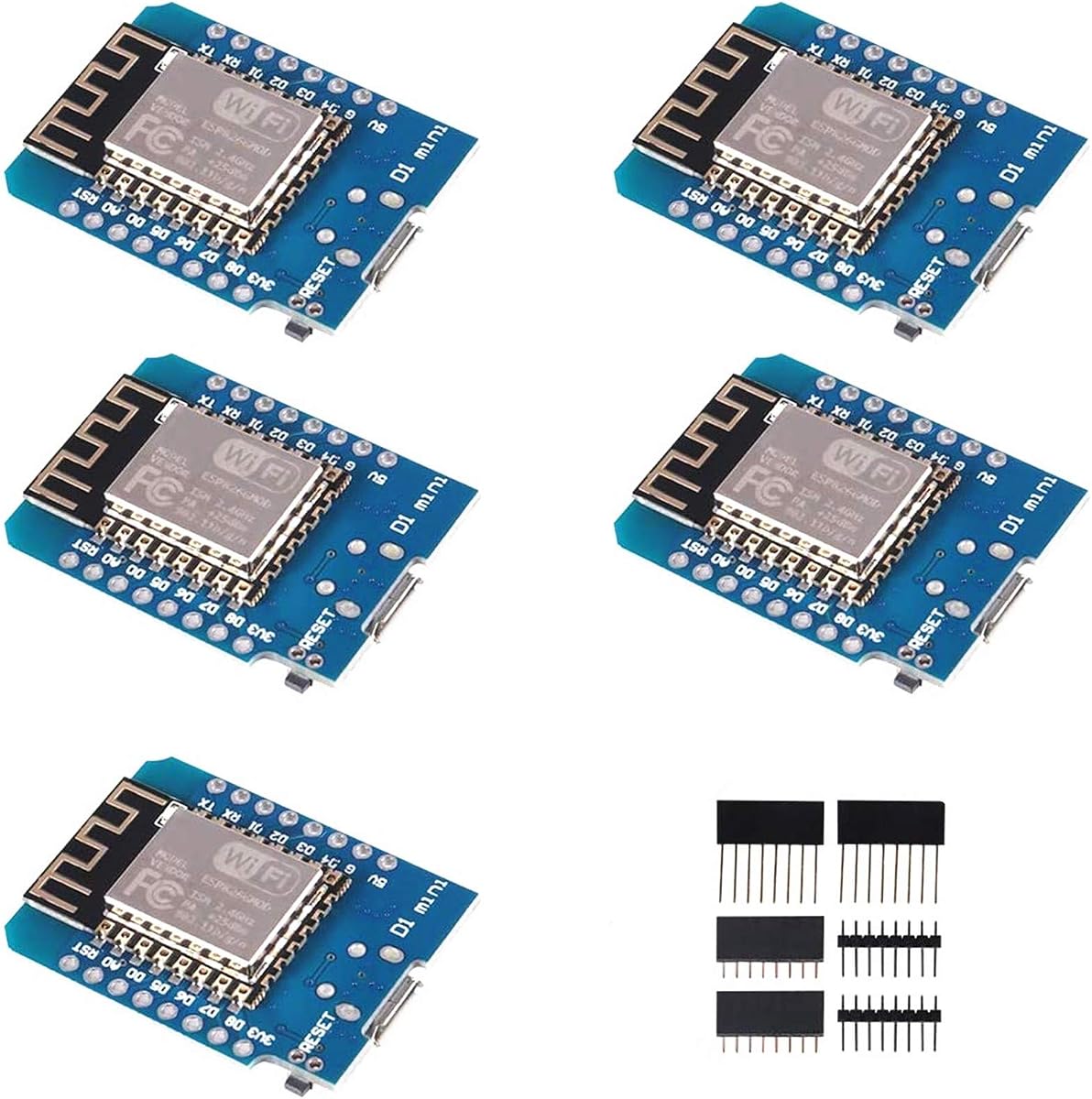
The D1 Mini variant offers 11 digital I/O pins and onboard switching power supply for compact WiFi development. With a 4.5 rating it supports Lua and Arduino IDE making it a versatile choice for small IoT devices.
We may earn a commission when you buy through this link, at no additional cost to you.
Each unit features Micro USB connection for programming and 4M Bytes flash memory allowing ample space for code and data. The integrated 5V 1A switching power supply simplifies power management without external regulators.
While Micro USB is slightly older it remains widely available and functional for most prototyping needs. The small size is ideal for wearable electronics and tight enclosures requiring wireless connectivity.
Select this board for projects needing a balance of size and functionality. The built-in power supply and rich pinout make it convenient for hobbyists and makers starting small wireless projects.
With 11 GPIO pins you can connect multiple sensors and actuators without needing external multiplexers.
The integrated switching power supply handles voltage conversion internally reducing external component requirements.
We may earn a commission when you buy through this link, at no additional cost to you.
This 10-pack provides the highest quantity of ESP8266 ESP-01 modules for large-scale testing or group projects. With a perfect 5.0 rating it offers robust on-board processing and ample storage for various wireless transceiver applications.
We may earn a commission when you buy through this link, at no additional cost to you.
Each module supports three distinct WiFi modes for versatile networking options and seamless integration with Arduino platforms. The LWIP stack in AP+STA mode streamlines development and enhances project compatibility for beginners.
Managing ten small modules requires organization to avoid losing pins or mislabeling. However the cost efficiency makes it an excellent choice for educational settings or distributed IoT sensor networks.
Choose this pack if you need bulk units for classroom labs or large production testing. The reliable processing power ensures each module can handle complex tasks independently.
Purchasing in bulk ensures all your units are identical reducing compatibility issues during system deployment.
The ESP8266 architecture provides sufficient onboard logic to execute complex algorithms without external processors.
We may earn a commission when you buy through this link, at no additional cost to you.
Selecting the right module depends on your specific connectivity needs, power constraints, and development preferences. We outline the key factors to consider before making your purchase.
Consider whether you need just Wi-Fi or both Wi-Fi and Bluetooth for your project. Newer ESP32-S3 chips offer Bluetooth 5.0 while older ESP8266 models only support Wi-Fi.
Bluetooth allows connections to mobile devices and peripherals, adding versatility to your smart device designs.
Modules with dual-core processors like ESP32 handle complex data processing better than single-core chips. This is vital for real-time applications or edge computing tasks.
Higher clock speeds enable faster execution of logic while freeing resources for network communication.
Flash memory capacity determines how much code and data your module can store. Look for 4MB units for large projects requiring extensive libraries.
Sufficient storage prevents compilation errors and supports offline data logging features effectively.
Most WiFi modules operate at 3.3V logic levels which require level shifters for 5V boards. Ensure your power supply is stable to prevent brownouts.
Voltage sensitivity is common so design your circuit with proper regulators and decoupling capacitors.
Integrated boards like Arduino UNO R4 include connectors while modules like ESP-01 are tiny bare chips. Choose based on your enclosure size constraints.
Smaller forms suit wearable electronics while larger boards simplify prototyping and debugging workflows.
Modern USB-C ports offer easier programming and power delivery compared to micro-USB. This improves workflow for new and existing projects.
Check that the physical connector matches your existing cables and power sources for convenience.
Ensure the module is compatible with Arduino IDE or your preferred development environment. Community support speeds up debugging and resource sharing.
Firmware updates and library availability are essential for long-term project maintenance.
Buying packs of multiple units can reduce the per-unit cost and provide spares for prototyping. Evaluate if a single board or bulk pack meets your needs.
Bulk buys are cost-effective for production testing but single units suffice for initial development phases.
Connect your module to your microcontroller using the correct pins. Ensure level shifting is applied for 5V boards to protect the WiFi chip.
Power the module with a stable 3.3V supply capable of providing at least 500mA during transmission spikes to prevent crashes.
Store your modules in a dry place to avoid moisture damage to the antenna and PCB traces during storage.
Most integrated boards have onboard antennas so they do not need external ones. Module versions like ESP-01 usually have a PCB antenna that works well indoors but external antennas can help range.
Yes, boards like Arduino Nano ESP32 support MicroPython for Python-based development. Others may require C++ or libraries like MicroPython ported for use.
Typical indoor range is around 30 to 50 meters depending on obstructions. External antennas and clear line of sight can significantly improve this distance.
This is often due to power brownouts. WiFi transmission spikes consume high current so ensure your supply can deliver stable 3.3V with sufficient amps.
Both are Arduino compatible but ESP32 offers dual-core performance and Bluetooth. You cannot swap them directly if the design relies on specific pins or voltage specs.
Use the Arduino IDE and select the correct board. For standalone modules like ESP-01 you need an external programmer or serial adapter.
ESP32 models often support OTA updates for easy firmware changes. ESP8266 boards may need specific libraries to enable OTA capabilities.
A stable regulated 3.3V supply with at least 1A output is ideal. Capacitors on the power line help smooth out current spikes during transmission.
We explored ten top options ranging from basic ESP8266 modules to advanced Arduino boards with dual-core processing and Bluetooth. Each offers unique strengths for different project needs.
Prioritize connectivity features like Bluetooth or memory capacity based on your application requirements. Consider whether a standalone module or integrated board fits your workflow best.
Prices and availability can vary so verify current listings before purchasing to ensure you get the best value for your project investment.
