
GHome Smart Plug WiFi Smart Plugs
4.4Editor score
Voice control with Alexa and Google
Remote access via mobile app
Group control for multiple devices
Discover the top 10 automatic light timers for 2026. Compare mechanical, digital, and smart plugs with real ratings to automate your home lighting efficiently.
Finding the right automatic light timer can transform how you manage home lighting and security. These devices allow you to schedule lamps and appliances easily, ensuring energy savings and convenience without manual intervention.
We have evaluated ten leading options based on durability, ease of use, and scheduling flexibility. Our comparison covers mechanical dials, digital programmable units, and smart plugs compatible with voice assistants for modern homes.
Each product highlight showcases key features, real user ratings, and ideal use cases. Please note that availability and offers may change, so verifying current details before purchasing is always recommended for the best experience.
4.4Editor score

4.4Editor score

4.4Editor score
This side-by-side overview helps you quickly identify which timer fits your specific automation needs. We compare key specs like programming options, outlet counts, and durability ratings across all ten selected models.



This BN-LINK digital timer stands out for its extensive programming capabilities. With up to eight on/off settings for two outlets, it offers granular control for complex schedules.
We may earn a commission when you buy through this link, at no additional cost to you.
Its standout features include a random vacation mode to deter intruders and a backup battery that preserves settings during power outages. The daylight savings toggle adds further convenience.
While it requires precise manual setup, the flexibility it provides outweighs the effort. The digital display ensures you always know your current schedule status.
Homeowners needing reliable, repeatable automation for lights and small appliances will find this model exceptionally useful for daily and vacation use cases.
The random mode varies lighting times to mimic occupancy, enhancing home security without extra effort.
Two grounded outlets allow control over multiple devices simultaneously, simplifying wiring needs.
We may earn a commission when you buy through this link, at no additional cost to you.
This WiFi smart plug modernizes lighting automation with voice and remote capabilities. It connects seamlessly to major smart home ecosystems, removing the need for physical timer dials.
We may earn a commission when you buy through this link, at no additional cost to you.
Users benefit from remote control via smartphone apps, allowing adjustments even when away from home. Voice commands make toggling devices effortless for hands-free operation.
It relies on a stable 2.4GHz network and app setup, which might limit users without strong home internet. However, once configured, it offers unmatched flexibility.
Tech-savvy homeowners seeking convenience and integration will appreciate the ease of managing lights and fans through voice or mobile control.
Control devices from anywhere using the GHome or Tuya app, ensuring lights are never left on accidentally.
Compatible with Alexa and Google Assistant, enabling quick voice commands to adjust schedules or power devices.
We may earn a commission when you buy through this link, at no additional cost to you.
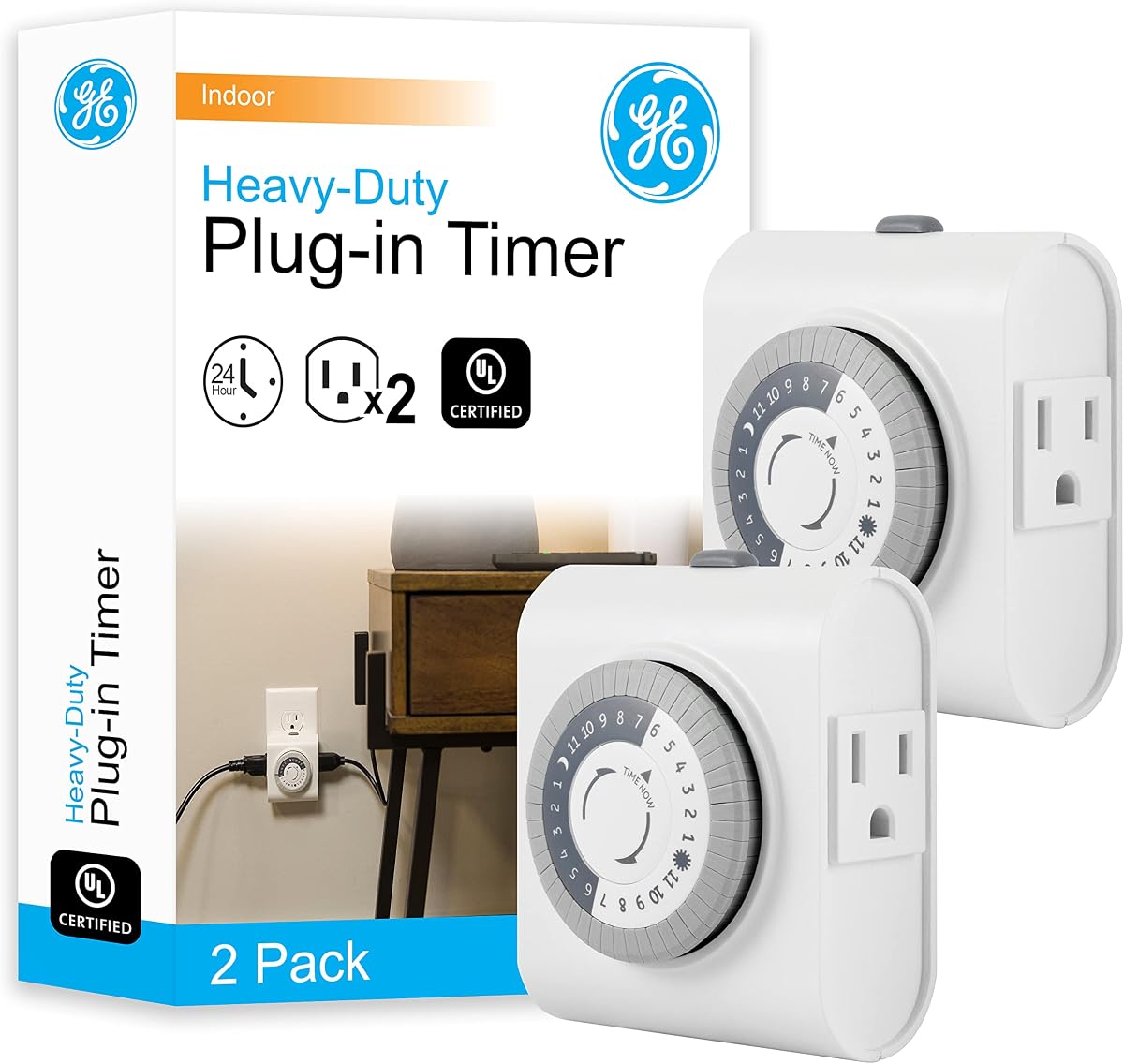
Offering a reliable mechanical solution at a budget-friendly price, this 2-pack allows basic automation without digital complexity. It features a streamlined design that saves outlet space.
We may earn a commission when you buy through this link, at no additional cost to you.
Setup involves pushing pins up or down to create your schedule, making it intuitive for users who dislike screens. The compact form factor reduces visual clutter.
Since it repeats daily and lacks memory during power cuts, you may need to reconfigure if power is lost. However, it remains a solid choice for simple daily cycles.
Budget-conscious shoppers needing straightforward control for lights or fans will find this mechanical set practical and cost-effective for indoor use.
Outputs located underneath prevent blocking adjacent outlets, maintaining accessibility for other plugged-in devices.
No complex menus; push pins for desired times to activate automated cycles instantly.
We may earn a commission when you buy through this link, at no additional cost to you.
This mini timer offers a discreet way to automate indoor outlets. Its small footprint ensures it does not protrude, preserving aesthetic simplicity.
We may earn a commission when you buy through this link, at no additional cost to you.
The 24-hour cycle with 30-minute intervals allows for standard daily routines. Being compatible with LED bulbs and small appliances adds to its versatility.
Without advanced features like multiple programs, it is best suited for consistent daily on/off patterns. Power loss requires resetting pins manually.
Those wanting a reliable, unobtrusive mechanical timer for lamps or holiday lights will find this set convenient and effective for basic automation.
Designed to minimize visual impact while maintaining full functionality for everyday devices.
Pins indicate on and off times clearly, reducing confusion during setup.
We may earn a commission when you buy through this link, at no additional cost to you.
This timer provides practical dual-outlet automation, saving valuable space. Its straightforward mechanical design ensures consistent performance with minimal fuss.
We may earn a commission when you buy through this link, at no additional cost to you.
A convenient override switch allows you to pause the cycle anytime without resetting, which is helpful for unplanned lighting needs.
It lacks multi-day programming, limiting use to daily routines. However, its robust construction and high user satisfaction make it a dependable choice.
For standard indoor automation like seasonal decor or lamps, this unit offers a balance of functionality and simplicity that meets most basic needs.
Power two devices with one plug, ideal for setups needing coordinated on/off cycles.
Instantly override programmed schedules when needed, ensuring flexibility during daily operations.
We may earn a commission when you buy through this link, at no additional cost to you.
This 2-pack extends digital convenience across multiple rooms. Each unit supports eight programs, allowing distinct schedules for living rooms and bedrooms alike.
We may earn a commission when you buy through this link, at no additional cost to you.
The LED indicator provides immediate visual confirmation of power status. Random modes simulate occupancy during travel, enhancing home security efficiently.
Power interruptions require manual resets, which can be a minor inconvenience. However, the detailed scheduling options offer significant control benefits.
Homeowners needing multiple timers with advanced digital features will find this set highly adaptable for whole-home lighting management.
Red LED lights confirm active status, preventing confusion about timer operation.
Random mode varies lighting to deter intruders while you are away from home.
We may earn a commission when you buy through this link, at no additional cost to you.
Ideal for bedrooms, this timer operates without audible clicks, ensuring sleep disturbances are minimized. Its sleek design blends seamlessly into modern decor.
We may earn a commission when you buy through this link, at no additional cost to you.
It preserves settings for up to three months after power loss, reducing the need for frequent resets. The screen displays current modes clearly.
Only one outlet is available, so simultaneous device control is limited. However, the precise scheduling and silent function make it a top choice.
For quiet, reliable automation in living spaces or bedrooms, this model offers a refined user experience with minimal disruption.
Silent internal mechanisms prevent clicking sounds during switching cycles.
Hold programmed settings for months even after disconnection, ensuring consistency.
We may earn a commission when you buy through this link, at no additional cost to you.
Built for exterior use, this timer withstands rain and weather fluctuations. Its durable casing ensures longevity in garden or porch environments.
We may earn a commission when you buy through this link, at no additional cost to you.
Dual grounded outlets handle pool pumps and lighting simultaneously. The mechanical pins are easy to set for basic on/off routines.
It must be mounted vertically to prevent water pooling. While mechanical, it retains settings even during power cuts effectively.
Outdoor enthusiasts needing rugged automation for holiday lighting or landscape features will find this model practical and reliable.
Protects internal components from moisture, ensuring consistent operation outdoors.
Mount at least 2ft above ground to maximize waterproof efficiency and safety.
We may earn a commission when you buy through this link, at no additional cost to you.
This timer is designed for seasonal automation, providing simple control for festive decorations. Its mechanical system is intuitive and reliable for daily cycles.
We may earn a commission when you buy through this link, at no additional cost to you.
With dual outlets, it manages multiple strings of lights from one source. The manual override helps bypass schedules when extra illumination is needed.
It lacks advanced features like random modes, limiting its utility to standard daily usage. However, its straightforward design minimizes user error.
Homeowners seeking a hassle-free solution for Christmas lights will find this timer effective and easy to maintain year after year.
Ideal for recurring seasonal tasks, reducing daily manual effort significantly.
No complex interfaces; just pull pins up for off to set your schedule.
We may earn a commission when you buy through this link, at no additional cost to you.
This model automates lighting based on ambient light levels, eliminating manual adjustments. It uses a photocell sensor to trigger on at dusk and off at dawn.
We may earn a commission when you buy through this link, at no additional cost to you.
Countdown options allow setting duration after sunset, offering flexibility beyond simple sunrise/sunset. It withstands rain and cold weather efficiently.
Sensor accuracy can be affected by external light pollution, so placement matters. Overall, it provides a smart approach to outdoor lighting management.
Gardeners and homeowners wanting hands-free outdoor illumination will appreciate its automatic detection and weatherproof capabilities.
Adjusts schedules automatically to match natural daylight cycles every day.
Structural design ensures performance during storms or temperature fluctuations.
We may earn a commission when you buy through this link, at no additional cost to you.
Selecting the right timer involves balancing features like programming flexibility, durability, and connectivity. This guide highlights the key factors to consider before making a decision.
Mechanical timers use physical pins for simple daily cycles, making them easy to set but limited in programming. Digital timers offer multiple programs, memory backup, and more complex scheduling options.
Choose digital if you need varied daily schedules, while mechanical suits basic repeating tasks.
Indoor timers typically lack weatherproof ratings, whereas outdoor models feature waterproof casings to withstand rain and dust. Using the wrong type can lead to safety hazards.
Always verify weatherproof ratings like IPX4 or similar for any exterior installation.
Some units provide dual outlets to control multiple devices, such as lamps and fans simultaneously. Single outlet timers restrict your control to one device at a time.
Dual outlets reduce the need for extra plugs and save valuable receptacle space.
Power outages can erase settings on timers without battery backup. Look for models with long-lasting memory chips or battery backups to retain schedules after interruptions.
This feature ensures your automation routine resumes immediately when power returns.
Modern smart plugs connect via WiFi or Bluetooth for remote control and voice integration. These options require stable internet but offer convenience for accessing schedules from anywhere.
Consider your home network strength before opting for smart connectivity solutions.
Certifications like ETL or UL indicate that a product meets specific safety standards for electrical components. Using certified timers reduces risks of fire or electrical failure.
Always check for recognized safety marks on the packaging or product listing.
Advanced digital models allow different schedules for weekdays versus weekends. This flexibility is essential for users who have varying routines throughout the week.
Select a timer that supports weekly or random modes for enhanced lifestyle adaptation.
Some timers require detailed menus while others use simple pushpins. Consider your technical comfort level and whether you prefer quick setups over detailed customization.
Simple interfaces reduce frustration and ensure consistent usage over time.
To set up a mechanical timer, rotate the dial to match current time, then push in pins to designate active periods. Ensure the pins are correctly aligned for the desired on/off cycles.
For digital timers, plug in the device and follow the instruction manual to set current time. Use the mode buttons to define start and end times, saving your changes to memory.
Maintain your timer by keeping it dry and dust-free, especially outdoor units. Avoid overloading the outlets by checking the wattage limits before connecting high-power appliances.
Yes, most modern timers are compatible with LED bulbs. Always check the wattage limits specified by the manufacturer to ensure safe operation. Some mechanical timers work better with resistive loads, but digital options support low-wattage LEDs.
Mechanical timers usually retain settings without battery backup, while digital ones may reset. Look for models with backup batteries to preserve schedules during blackouts. Manual intervention might be needed to reprogram if no backup is present.
Outdoor timers are designed with waterproof casings to resist rain, but they should not be submerged. Proper installation includes mounting them vertically to prevent water accumulation. Always check the IP rating for specific water resistance.
Resetting typically involves holding a specific button or cycling through the mode settings. Refer to the instruction manual for precise steps as models vary. If the battery is drained, replace it to ensure the device responds correctly.
Most timers can handle standard fan loads if the wattage is within limits. However, avoid using them with high-power ceiling fans unless rated for such appliances. Check the amperage rating before connecting motorized devices.
Traditional digital timers do not require Wi-Fi for operation; they rely on internal clocks. Smart plugs or advanced connected units need a network for remote features. Standard programmable models function independently without internet access.
Our top picks cover mechanical simplicity, digital precision, and smart connectivity. Whether you need a basic budget option or advanced automation, there is a model to suit your requirements.
Prioritize safety certifications and durability based on your intended environment. Indoor and outdoor settings demand different levels of weather resistance and power management.
Remember to verify current availability and specifications before purchasing. Regular maintenance and correct usage will ensure your timer performs reliably for years to come.