
PRV AUDIO DSP 2.4X
4.7Editor score
LCD Display Interface
4 Channel Crossover Outputs
Remote Sequencer Feature
Discover the top 10 Digital Signal Processor Dsp for Car Audio units. Compare features, ratings, and real user feedback to find the perfect audio processor for your vehicle.
Digital Signal Processor Dsp for Car Audio units are essential for unlocking the full potential of your vehicle sound sound system. These devices allow precise control over equalization, crossovers, and time alignment to ensure every speaker performs at its peak.
We compared ten leading models based on their channel counts, processing power, connectivity options, and user interfaces. Each product was evaluated for its ability to integrate with factory and aftermarket systems while delivering high-quality audio processing capabilities.
Each pick highlights specific strengths like Bluetooth control, high-level inputs, or advanced parametric EQ. Prices and availability can change, so verify current details before purchasing to ensure you get the best value for your specific audio upgrade needs.
4.7Editor score
4.6Editor score

4.6Editor score
This side-by-side comparison helps you visualize the key specifications and features across all ten top-rated DSP units. Use this table to quickly identify which model matches your channel requirements and budget constraints.





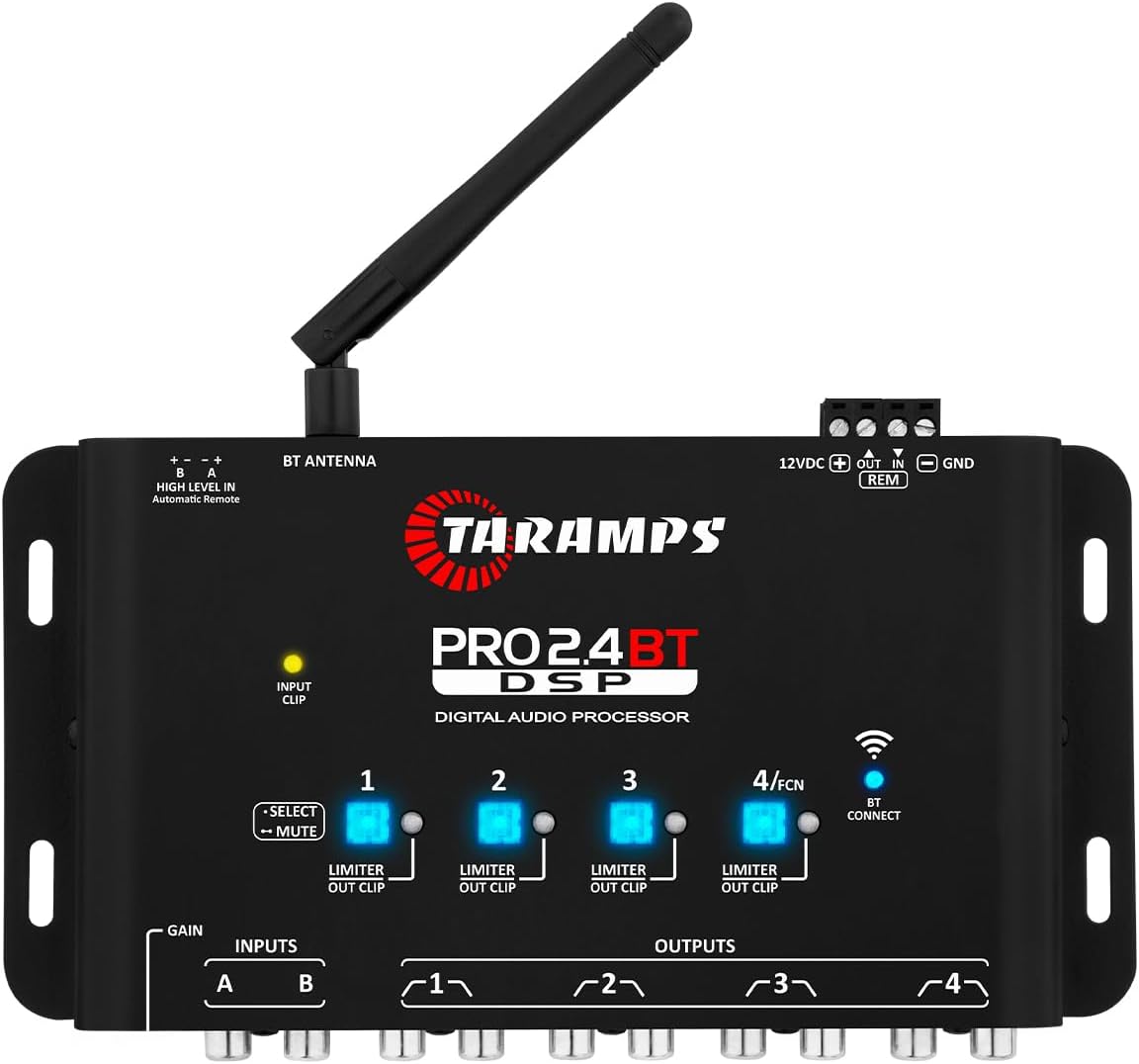
The Taramps Pro 2.4 BT stands out as the top choice for modern car audio enthusiasts seeking complete control over their sound systems. With a robust 4.6 rating, it delivers exceptional versatility through its Bluetooth 5.4 connectivity, allowing users to wirelessly adjust every parameter from a smartphone or tablet.
We may earn a commission when you buy through this link, at no additional cost to you.
Its standout feature is the total audio control it provides, featuring a 15-band graphic EQ and 12 presets for quick tuning. The unit supports high level inputs and auto turn-on, making it seamless to integrate with factory head units without extensive rewiring.
Trade-offs include reliance on the app for deep configuration which might be challenging for beginners. However, the secure preset sharing and encryption ensure your custom tunes are safe and can be easily shared or backed up remotely.
This processor is ideal for daily drivers, custom builds, or anyone wanting professional-grade optimization in a compact package. Its intuitive interface and rugged design make it a reliable upgrade for enhancing clarity and imaging in any vehicle.
High level inputs allow direct connection to factory wiring without replacing the head unit.
24-bit 48kHz processing ensures pristine audio fidelity across all speaker channels.
We may earn a commission when you buy through this link, at no additional cost to you.
The PRV AUDIO DSP 2.4X offers outstanding value for those seeking professional DSP capabilities at a budget-friendly price. Boasting a 4.7 rating, this unit is praised for its intuitive LCD display which simplifies real-time audio adjustments directly on the device.
We may earn a commission when you buy through this link, at no additional cost to you.
It handles versatile needs with two audio inputs and four independent outputs, allowing users to select different source mixes. The integrated equalization system includes 12 presets and a 15-band graphic EQ for flexible sound shaping.
While it lacks wireless control, the dedicated display ensures quick access without phone pairing. The sequencer feature allows triggering other products like amplifiers, streamlining system startup sequences effectively.
Ideal for builders who prefer manual controls or need a reliable unit for OEM upgrades. Its straightforward design ensures you get high performance without paying for extra connectivity features you might not use.
The LCD display lets you tweak settings on the fly without needing a smartphone.
The sequencer enables automatic startup of connected audio gear via remote relay.
We may earn a commission when you buy through this link, at no additional cost to you.
Expanding on the 2.4X model, the PRV AUDIO DSP 2.8X provides eight independent output channels for complex setups. It maintains the same user-friendly interface and high rating, making it perfect for systems with multiple amplifiers or rear-seat zones.
We may earn a commission when you buy through this link, at no additional cost to you.
The unit supports two inputs and eight outputs with independent crossover settings, allowing detailed tuning across the entire vehicle. The LCD screen and 12 presets help streamline the tuning process even with more channels involved.
Managing eight channels requires more attention but offers unmatched flexibility for custom builds. The absence of Bluetooth remains a minor drawback compared to newer units but the physical controls ensure reliability.
Buy this if you need more outputs without sacrificing simplicity. It serves well for advanced audio enthusiasts managing multi-zone or high-fidelity systems where precise routing is critical.
Eight outputs allow separate tuning for subwoofers, midrange, and rear passengers.
Same robust processing quality as the 2.4X but scaled for larger projects.
We may earn a commission when you buy through this link, at no additional cost to you.
This Bluetooth-enabled variant of the PRV DSP caters specifically to users upgrading factory sound systems. While it has a lower rating, its inclusion of high-level inputs simplifies connection to OEM units without extra converters.
We may earn a commission when you buy through this link, at no additional cost to you.
It offers 21 crossover filter options and limiter controls, giving fine-grained adjustments. The exclusive PRV speaker presets are a unique benefit, pre-configuring optimal crossovers for their own drivers to save tuning time.
The lower rating suggests potential connectivity issues, but the hardware flexibility is strong. If you want a balance of control and OEM compatibility, this model provides essential tools for modernizing older vehicles.
Perfect for DIYers using PRV speakers or factory radios. The Bluetooth feature adds convenience, though stability might vary compared to dedicated Bluetooth units.
Pre-configured crossover presets save time when using PRV components.
Butterworth, Linkwitz-Riley, and Bessel filters for precise crossover slopes.
We may earn a commission when you buy through this link, at no additional cost to you.
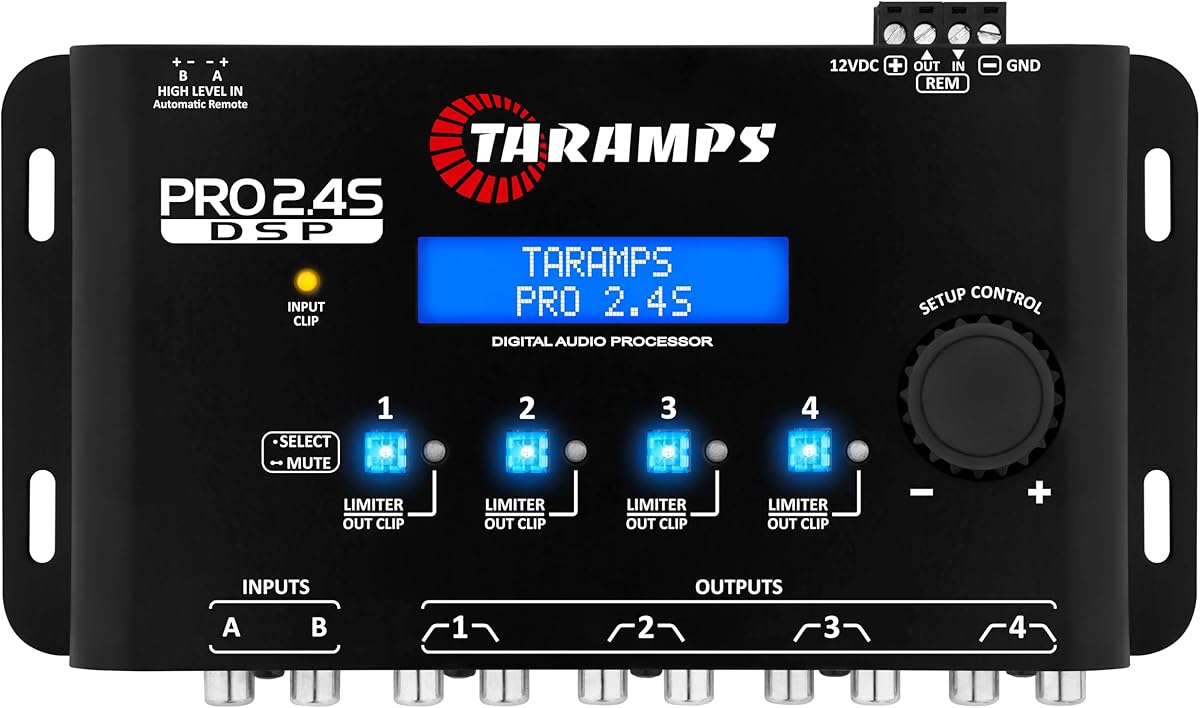
The Taramps PRO 2.4S focuses on delivering a clean, compact solution for sound tuning. It holds a strong 4.6 rating and includes an Anti-Pop System to eliminate turn-on and turn-off noises, ensuring a smooth listening experience.
We may earn a commission when you buy through this link, at no additional cost to you.
With full 15-band graphic EQ and active crossovers, it supports precise frequency distribution. The high-level input simplifies installation into factory systems, removing the need for extra harnesses.
Though it lacks Bluetooth, the manual interface is straightforward and reliable. Its small footprint makes it ideal for installations where space is tight without sacrificing audio processing quality.
Buy this for simple OEM upgrades or active speaker setups. Its reliability and noise protection features make it a solid choice for daily drivers.
The Anti-Pop System ensures no unwanted clicks when the system powers up.
RCA and high-level inputs ensure compatibility with any head unit type.
We may earn a commission when you buy through this link, at no additional cost to you.
For audiophiles demanding the highest fidelity, the Banda Audiopart X8AiR offers top-tier performance. With 32-bit/96kHz processing and a staggering 79-band equalizer per channel, it provides granular control over every frequency.
We may earn a commission when you buy through this link, at no additional cost to you.
The eight-channel output supports multi-amplifier setups and complex configurations. Bluetooth control via a dedicated app allows real-time tweaks, making fine-tuning convenient from the driver's seat.
The high price and complex interface require dedication to master fully. But for those pursuing absolute sound quality and deep customization, its resolution and bandwidth are unmatched.
Ideal for show cars or critical listening environments. Its ability to reduce distortion and enhance bass control justifies the investment for serious enthusiasts.
79-band EQ allows surgical adjustments to fix specific resonances or peaks.
32-bit/96kHz architecture ensures crystal clear sound without digital artifacts.
We may earn a commission when you buy through this link, at no additional cost to you.
The Taramps PRO 2.8S extends the 2.4S functionality to eight channels for larger audio projects. It brings Dynamic DSP mode for advanced control over peak and RMS limiters, ensuring protection for high-power systems.
We may earn a commission when you buy through this link, at no additional cost to you.
Its 15-band graphic EQ and delay controls help align speakers for better imaging. The unit supports high-level inputs and auto turn-on, simplifying integration into factory vehicles.
Without app control, tuning relies on physical adjustments or software. But the hardware specs are solid for complex builds where more outputs are essential for full system coverage.
Choose this for multi-zone setups needing reliable processing. The extra channels allow independent control of subs, mids, and tweeters effectively.
Dynamic DSP mode limits peak power to prevent distortion or speaker damage.
Eight outputs mean every speaker channel can be tailored independently.
We may earn a commission when you buy through this link, at no additional cost to you.
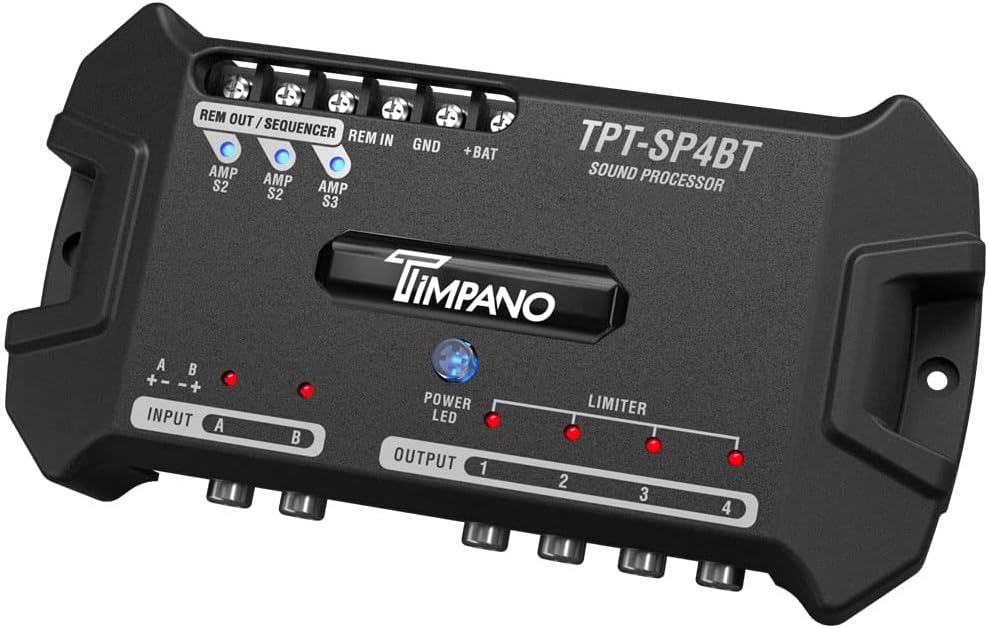
The Timpano TPT-SP4BT stands out with a built-in voltmeter for monitoring battery health. This feature is ideal for systems with large amps where voltage dips can impact performance or cause issues.
We may earn a commission when you buy through this link, at no additional cost to you.
It supports Bluetooth app control for wireless adjustments and includes a sequencer for remote startup of products. The frequency generator helps test speaker response without external tools.
While support is limited, the core tools provide robust tuning capabilities. The voltmeter adds a layer of diagnostics not found on most other DSPs in this range.
Best for custom builds needing voltage monitoring. Its remote relay and Bluetooth features make it a versatile addition to performance audio setups.
The built-in voltmeter tracks system voltage in real time during playback.
Bluetooth app lets you adjust EQ and crossover settings from your phone.
We may earn a commission when you buy through this link, at no additional cost to you.
The Dayton Audio DSP-408 offers versatile I/O for mixing different sources or multi-channel setups. It features a graphical user interface which simplifies complex tuning tasks compared to basic menus.
We may earn a commission when you buy through this link, at no additional cost to you.
With full parametric EQ on all outputs, it delivers professional results for both home and car audio. The mixing capabilities allow blending signals from multiple inputs into any output.
Its rating is lower due to setup complexity and lack of Bluetooth. But for those needing flexible routing and deep EQ, it is a powerful tool for precise sound engineering.
Use this for multi-source projects or high-fidelity setups. The input mixing makes it ideal for systems integrating different audio feeds or streaming devices.
Four inputs let you mix different audio sources into any output channel.
Adjustable parametric EQ gives fine control over frequency response curves.
We may earn a commission when you buy through this link, at no additional cost to you.
The Stetsom STX2448 FLOATING PRO brings a unique Floating Mode that changes how audio streams are processed. This allows varied configurations and expanded possibilities for complex system designs.
We may earn a commission when you buy through this link, at no additional cost to you.
It includes subharmonic bass generation to enrich low frequencies and features a remote sequencer for automated control. Input levels are adjustable with clip LEDs to monitor signal health.
The learning curve is steeper due to these advanced features. But for those wanting innovative DSP behavior beyond standard fixed flows, it offers distinct advantages for specialized builds.
Ideal for advanced custom audio engineering. The Floating Mode allows creative routing options that standard DSPs cannot provide.
Floating Mode supports different flows allowing complex audio routing options.
Subharmonic bass generation extends the low-end response for deeper impact.
We may earn a commission when you buy through this link, at no additional cost to you.
Selecting the right DSP requires understanding your system size, desired features, and integration needs. This guide covers the essential factors to consider before purchasing a digital signal processor.
The number of output channels determines how many speakers or amplifiers you can control independently. A 4-channel DSP suits basic setups, while 8-channel models support complex systems with separate subwoofers and tweeters.
Choose a unit with enough outputs to cover your current speakers and room for future upgrades.
Ensure the DSP supports your existing head unit type. High-level inputs allow direct connection to factory speaker wires, while RCA inputs are standard for aftermarket units.
Look for units with both options to maximize compatibility across different vehicle models and audio configurations.
Decide between physical controls, LCD displays, or app-based Bluetooth control. Bluetooth apps offer convenience but require stable connections, while physical interfaces ensure immediate adjustments.
Pick the interface style that matches your technical comfort level and setup frequency.
Check the number of EQ bands and available crossover options. 15-band graphic EQ is common, while 32-bit processors may offer 79 bands for surgical tuning of specific frequencies.
More EQ bands provide finer control over sound quality but require more experience to tune effectively.
For quick setup, look for units with manufacturer presets or auto-turn-on features. These reduce installation time and ensure the system initializes correctly with your vehicle.
Preset sharing and encryption features add value for sharing custom tunes with others.
Higher bit rates like 32-bit/96kHz offer better dynamic range and lower distortion. This matters most for audiophiles seeking pristine sound fidelity across the frequency spectrum.
Standard 24-bit processors are sufficient for daily drivers and most performance upgrades.
Tools like limiters, delay controls, and sequencers add depth to your tuning capabilities. Voltmeters or frequency generators help with diagnostics and testing during installation.
Prioritize features that directly impact your specific setup needs and technical workflow.
Start by connecting the DSP to your head unit and amplifiers using high-quality cables. Ensure all ground points are secure and clean to prevent noise or distortion issues in your audio output.
Use the software or app to adjust your crossover points and EQ settings. Begin with flat presets and gradually tweak bass and treble to match the acoustics of your vehicle cabin.
Regularly update firmware via Bluetooth or USB to access new features and bug fixes. Protect the unit from extreme heat and moisture to ensure long-lasting performance and reliability.
No, many DSPs include high-level inputs that connect directly to factory speaker wires. This allows you to upgrade audio quality without changing the original radio unit in your vehicle.
A DSP provides precise control over timing, frequency, and volume for each speaker. This corrects factory audio limitations to improve imaging, clarity, and overall sound balance.
Yes, most DSPs feature RCA outputs designed to work with aftermarket amplifiers. You can route specific frequency bands to dedicated amps for better system integration.
A 4-channel DSP typically supports four outputs, allowing you to control two front speakers and two rear speakers independently for customized sound distribution.
Bluetooth apps offer remote convenience but physical buttons provide reliability. Choose based on whether you prefer phone access or quick on-device adjustments during setup.
Yes, you can tune the crossover and EQ to optimize factory subs. This enhances bass response without requiring a complete system overhaul or hardware replacement.
The Taramps Pro 2.4 BT leads our list with its wireless convenience and robust feature set. The PRV AUDIO models offer excellent budget-friendly alternatives with strong performance for basic upgrades.
When choosing, prioritize channel count and input compatibility first. Your system size and current head unit dictate which model will fit best without extra adapters or wiring.
Prices and stock fluctuate frequently. Always verify the current details and specs before purchasing to ensure the unit meets your specific audio goals and needs.