
Westinghouse 12500 Watt Dual Fuel Home Backup Portable Generator
4.7Editor score
Remote Electric Start
12500 Peak Watts
Transfer Switch Ready
Explore our expert guide to the best portable generators. Compare top models, real ratings, and key features to find the perfect power source for your home or outdoor needs.
Portable generators provide essential backup power during outages or off-grid adventures. Choosing the right model requires balancing wattage, fuel type, run time, and safety features to meet your specific energy demands.
We analyzed nine top-rated portable generators from leading brands like Westinghouse, DuroStar, WEN, and Jackery. Our comparison focuses on real user ratings, technical specs, and versatility for home backup or recreational use.
Each pick below highlights standout features, pros, and cons to help you decide. Note that product availability and pricing fluctuate frequently, so verify current details before making your final purchase decision.
4.7Editor score

4.8Editor score

4.6Editor score
This side-by-side comparison highlights the core specifications of all nine portable generators to help you quickly identify which model aligns with your power needs and budget constraints.



The Westinghouse 14500 Tri-Fuel generator stands out as a top performer with a 4.8 rating. Its ability to run on gasoline, propane, or natural gas makes it the most versatile choice for diverse backup needs.
We may earn a commission when you buy through this link, at no additional cost to you.
Its 19-hour run time on gasoline ensures sustained power during extended outages. Low THD protects sensitive electronics like laptops and medical devices. The heavy-duty 550cc engine with cast iron sleeves delivers reliable performance.
While its weight and price reflect its high power, the flexibility and run time justify the investment. You save money on fuel costs by switching to propane or natural gas when possible.
Buy this if you need a reliable, versatile backup for a large home or frequent outdoor use. It balances raw power with fuel flexibility and electronic safety effectively.
Switch between gasoline, propane, and natural gas seamlessly for optimal fuel availability and cost efficiency.
Enjoy up to 19 hours of continuous power on a single tank, minimizing refueling interruptions during critical outages.
We may earn a commission when you buy through this link, at no additional cost to you.
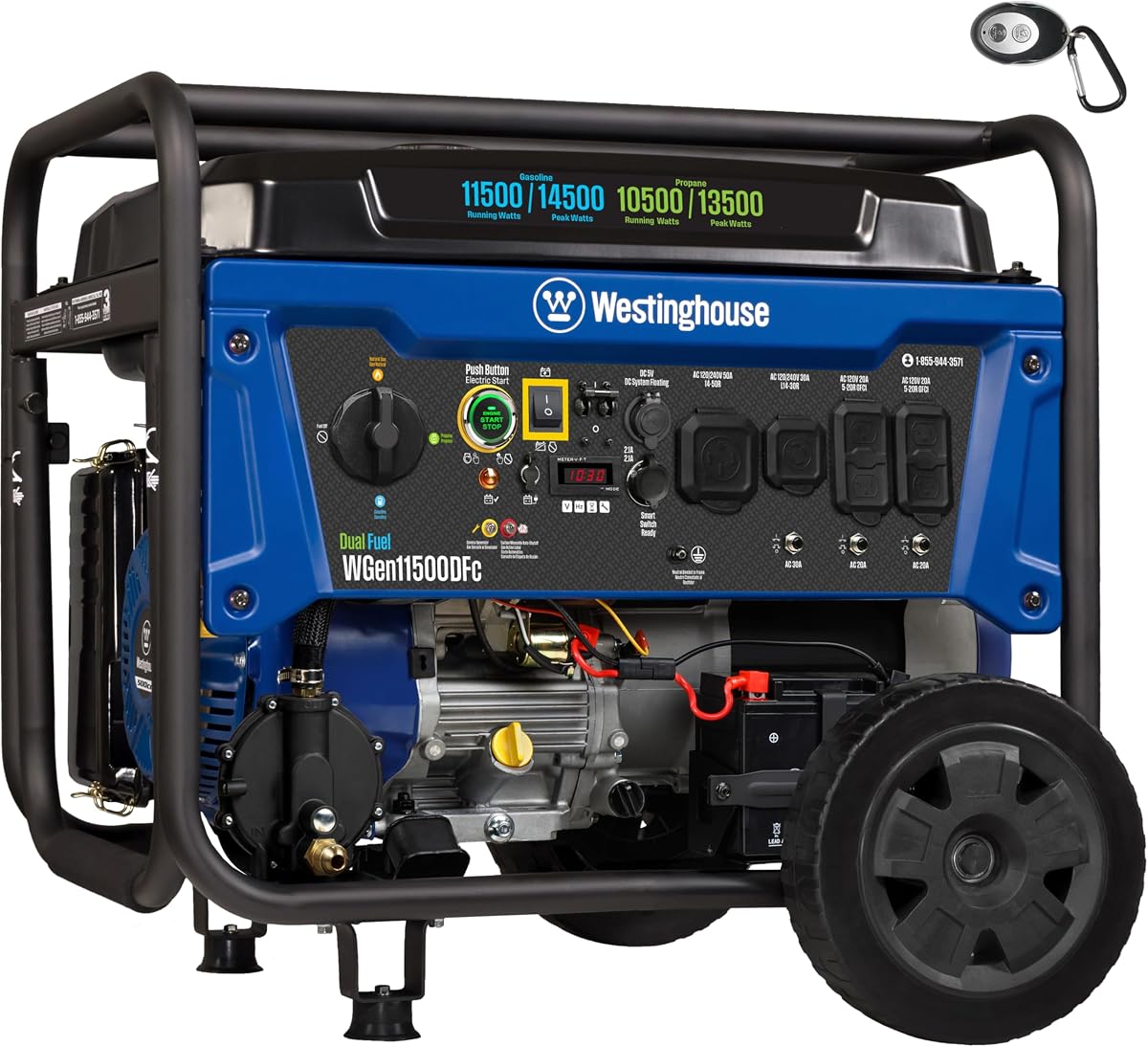
The Westinghouse 12500 Dual Fuel earns a 4.7 rating for its powerful output and convenient remote start feature. It excels in starting the unit from a distance, adding safety and ease of use.
We may earn a commission when you buy through this link, at no additional cost to you.
With 12500 peak watts, it handles heavy loads like central AC units. The VFT display provides real-time voltage and frequency data. It includes a key fob, tool kit, and oil for immediate plug-and-play setup.
Its two-fuel limitation compared to tri-fuel models reduces fuel flexibility. However, the robust build and remote start functionality offer significant convenience for homeowners prioritizing ease of use.
Choose this generator if remote starting and strong surge capacity are your top priorities. It delivers premium features suited for whole-home backup scenarios.
Use the included key fob to start the generator from a safe distance without manual pulling or proximity.
Track voltage, frequency, and engine hours with the VFT digital display for better performance oversight.
We may earn a commission when you buy through this link, at no additional cost to you.
The Jackery Explorer 300 scores 4.6 for its portability and quiet operation. It is an excellent budget choice for camping, tailgating, or powering small electronics during short outages.
We may earn a commission when you buy through this link, at no additional cost to you.
Weighing just 7.5 pounds, it is easy to carry anywhere. Its LiFePO4 battery supports over 4000 cycles. The 292Wh capacity powers phones, laptops, and CPAP machines but not heavy kitchen appliances.
Users seeking whole-home backup will find its capacity insufficient. Still, its silent performance, solar rechargeability, and low weight make it ideal for portable, low-power needs.
Opt for this if you need lightweight, silent power for gadgets or small appliances. It offers the best value for lightweight users seeking reliability without noise.
At only 7.5 lbs, it is easy to pack for hikes or carry effortlessly to emergency locations.
The LiFePO4 battery delivers over 4000 cycles for more than 11 years of reliable use.
We may earn a commission when you buy through this link, at no additional cost to you.
The Westinghouse 6500 Dual Fuel earns a 4.5 rating as an affordable backup option. It balances cost, run time, and essential safety features for smaller homes and essential circuit support.
We may earn a commission when you buy through this link, at no additional cost to you.
Its 6500 peak watts cover basics like refrigerators and lights. The CO sensor shuts down the unit if dangerous carbon monoxide levels are detected. You get up to 14.5 hours of run time on a single tank.
It lacks remote start or tri-fuel options found in higher-end models. However, it delivers reliable, safe backup power at a lower price point for essential needs.
Select this for budget-conscious homeowners needing reliable backup for essential circuits. It offers solid value with vital safety features like CO monitoring.
Automatic carbon monoxide detection shuts down the generator if dangerous fume levels are detected nearby.
With up to 14.5 hours on a single tank, it sustains essential loads through overnight outages.
We may earn a commission when you buy through this link, at no additional cost to you.
The Westinghouse 14500 Dual Fuel rates 4.6 for its robust power and run time. It provides substantial wattage for whole-house backup while maintaining compatibility with clean energy for electronics.
We may earn a commission when you buy through this link, at no additional cost to you.
Its 14500 peak watts support large appliances. Low THD ensures safety for sensitive electronics. The 550cc engine provides 19 hours of gasoline run time. Durable copper windings help the generator stay cooler.
Its high power demands more maintenance and fuel. Also, the dual-fuel option limits flexibility compared to tri-fuel. Still, it is a powerhouse for users needing consistent high-output energy.
Buy this if high wattage and long run time are critical. It suits large homes requiring reliable, high-capacity backup power.
14500 peak watts deliver enough power for multiple large appliances during severe weather or grid failures.
Clean power output protects sensitive electronics like TVs and computers from voltage fluctuations.
We may earn a commission when you buy through this link, at no additional cost to you.
The Jackery Explorer 1000 v2 scores 4.7 for its fast charging and capacity balance. It bridges the gap between small power stations and traditional generators for versatile, clean power.
We may earn a commission when you buy through this link, at no additional cost to you.
Its 1500W output powers small appliances like fridges. The 1070Wh capacity lasts longer. A one-hour emergency charge helps when grid power is available. The App allows control over charging modes.
It depends on Jackery solar panels for optimal off-grid use. Also, it lacks fuel-based refueling options. Still, its fast recharge and long lifespan make it a modern, reliable choice.
Choose this for clean, fast-rechargeable power for moderate needs. It suits users seeking modern battery technology and portability.
Charge from 0 to 100% in just one hour using emergency mode via the Jackery App.
Manage charging modes, monitor battery health, and optimize power usage from your smartphone.
We may earn a commission when you buy through this link, at no additional cost to you.
The DuroStar DS13000MX earns a 4.3 rating for its high power and home backup readiness. It handles major loads like central AC and multiple appliances through its 50A outlet.
We may earn a commission when you buy through this link, at no additional cost to you.
Its all-metal frame ensures durability. The CO Alert feature provides critical safety during indoor-adjacent operation. Dual-fuel capability extends refueling flexibility. Remote start offers convenient operation.
Its weight and noise may deter recreational users. However, its robust build and whole-home capability make it strong for emergency backup where power reliability is paramount.
Pick this if you need high power for home essentials and job sites. It offers sturdy construction with essential safety features like CO alerts.
Connect directly to a transfer switch using the 50A outlet to power whole-home electrical systems.
All-metal construction ensures longevity and reliability under harsh outdoor or weather conditions.
We may earn a commission when you buy through this link, at no additional cost to you.
The WEN 6800 Dual Fuel rates 4.4 as an RV-ready inverter generator. It provides cleaner power and unique charging features tailored for electric vehicle support and mobile applications.
We may earn a commission when you buy through this link, at no additional cost to you.
Its inverter technology ensures stable voltage. Bonded-neutral configuration supports Level 2 EV charging. The CO Watchdog enhances safety. Fuel shutoff extends engine life. It includes RV-ready outlets and USB ports.
Its lower rated watts limit whole-home use. Still, it excels for RV and outdoor use needing clean power and electric vehicle charging compatibility.
Buy this if you need inverter-grade clean power for RVs or EVs. It combines safety with tailored features for mobile power users.
Bonded-neutral 240V configuration supports Level 2 charging for hybrid or electric vehicles.
Clean inverter output ensures safe, stable power for sensitive electronics and onboard devices.
We may earn a commission when you buy through this link, at no additional cost to you.
The Westinghouse 4650 Peak Watt earns 4.6 as an entry-level option. It delivers essential power for small homes or outdoor events with built-in safety and user-friendly setup.
We may earn a commission when you buy through this link, at no additional cost to you.
Its 3600 running watts cover basics. The CO sensor protects against fumes. You get 14 hours of run time. It includes tools and oil for immediate use. The 212cc engine is simple and reliable.
It lacks propane support and high wattage. Still, its price, light weight, and reliable safety features make it an excellent starter generator.
Choose this for budget-friendly power for essential appliances. It is best for users who prioritize cost and safety over high output.
Built-in carbon monoxide detection protects you by shutting down the unit when dangerous fume levels are detected.
Comes with oil, funnel, and tools for quick setup right out of the box.
We may earn a commission when you buy through this link, at no additional cost to you.
Selecting the right portable generator requires evaluating your power needs, fuel preferences, and desired features to ensure reliable, safe, and cost-effective energy.
Calculate your total wattage needs by adding the running watts of all devices and ensuring the generator’s surge capacity covers startup peaks. For whole-home backup, aim for 7000 to 12000+ watts; for essentials, 4000 to 6000 may suffice.
Always prioritize generators that exceed your highest startup surge to prevent overloads and ensure smooth operation.
Choose between gasoline, propane, natural gas, or dual/tri-fuel options based on availability and cost. Dual or tri-fuel generators let you switch fuels during outages, extending run times and reducing fuel scarcity risks.
Gasoline is common but degrades; propane stores longer. Natural gas requires hookups. Tri-fuel models offer maximum flexibility for emergency preparedness.
Look for run times of 10+ hours per tank to reduce refueling. Check how the generator performs at partial loads, as efficiency varies. Larger tanks and efficient engines extend uptime significantly.
Long run times mean less disruption and fuel logistics. Aim for models with at least 10–14 hours under moderate load.
CO sensors, low oil shutdown, and automatic circuit breakers are vital. Carbon monoxide detectors protect against indoor risks. Low oil sensors prevent engine damage. Proper grounding and rubber outlet covers add extra safety.
Never place generators near doors or windows. Use CO sensors to avoid poisoning risks. Prioritize models with these safety systems for family protection.
Consider weight and wheel kits. Heavy units require sturdy frames, handles, or wheels. Lighter models are easier to move but offer less power. For RV or camping, aim under 50 pounds.
Check the included wheel kit and handle design. Portable power stations are lighter than fuel generators but offer lower capacity.
Ensure the generator has the outlets you need, including 120V household, 240V transfer switch, RV-ready TT-30R or 14-50R, and USB. Some models include 240V for EV charging.
Outlet variety determines versatility. RV-ready and transfer switch outlets simplify connections for homes and campers.
Inverter generators run quieter and provide cleaner power for sensitive electronics. Check decibel ratings; below 65 dB is ideal for residential use. Traditional generators are louder but often more powerful.
Inverters reduce noise pollution and protect gadgets. Choose them for campsites or neighborhoods where noise matters.
Look for warranties covering parts, labor, and service. Three-year limited warranties are common. Check manufacturer support networks and availability of spare parts for long-term maintenance.
Strong warranty terms protect your investment. Brands with nationwide service networks ensure faster repairs and reliability.
Position the generator outdoors at least 20 feet from doors and windows to prevent carbon monoxide poisoning. Ensure it sits on a dry, flat surface away from precipitation and flammable materials.
Use proper extension cords rated for the generator’s output. For home backup, connect via a transfer switch installed by a licensed electrician to avoid backfeeding and grid hazards.
Refuel only when the engine is off and cool. Store fuel in approved containers away from living areas. Regularly inspect spark plugs, air filters, and oil levels before each use.
Running watts are the power needed to keep appliances running. Peak watts are the extra burst needed to start motors. Always size your generator for peak wattage to handle startup loads without tripping.
Yes, with generators rated 8000 watts or higher and proper transfer switches. Connect only essential circuits like refrigerators and HVAC. Avoid overloading by prioritizing critical loads and checking total wattage.
Only if under a proper canopy and with GFCI outlets. Never operate in direct rain. Use weatherproof covers and ensure dry connections to prevent electrical hazards and engine damage.
Change oil every 50–100 hours. Replace air filters annually. Drain or stabilize fuel for storage. Check spark plugs and battery regularly. Follow the manual for specific intervals and procedures.
Propane stores indefinitely without degradation. Gasoline lasts 6–12 months with stabilizers. Dual-fuel models let you use propane when gasoline is scarce, making it ideal for emergency preparedness.
Yes, for whole-home backup, install a transfer switch by an electrician. DIY interlocks risk backfeeding. Simple outlet connections are possible, but professional work ensures safety and code compliance.
Some models like the WEN 6800 support Level 2 charging. Verify 240V compatibility and output wattage. Use dedicated adapters or charging stations rated for generator input to prevent damage.
Yes for electronics and noise. Inverters provide clean, stable power and run quieter. Traditional generators offer more power at lower cost. Choose inverters for sensitive devices and residential areas.
Our top picks include the Westinghouse 14500 Tri-Fuel for versatility, the 12500 Dual Fuel for remote convenience, and the Jackery 300 for budget-friendly portability.
Prioritize wattage needs, fuel flexibility, and safety features like CO sensors. Match the generator to your specific use case, whether home backup, RV travel, or outdoor events.
Check current pricing and availability before buying. Verify warranty terms and outlet compatibility. With the right choice, you ensure reliable, safe power whenever you need it most.